
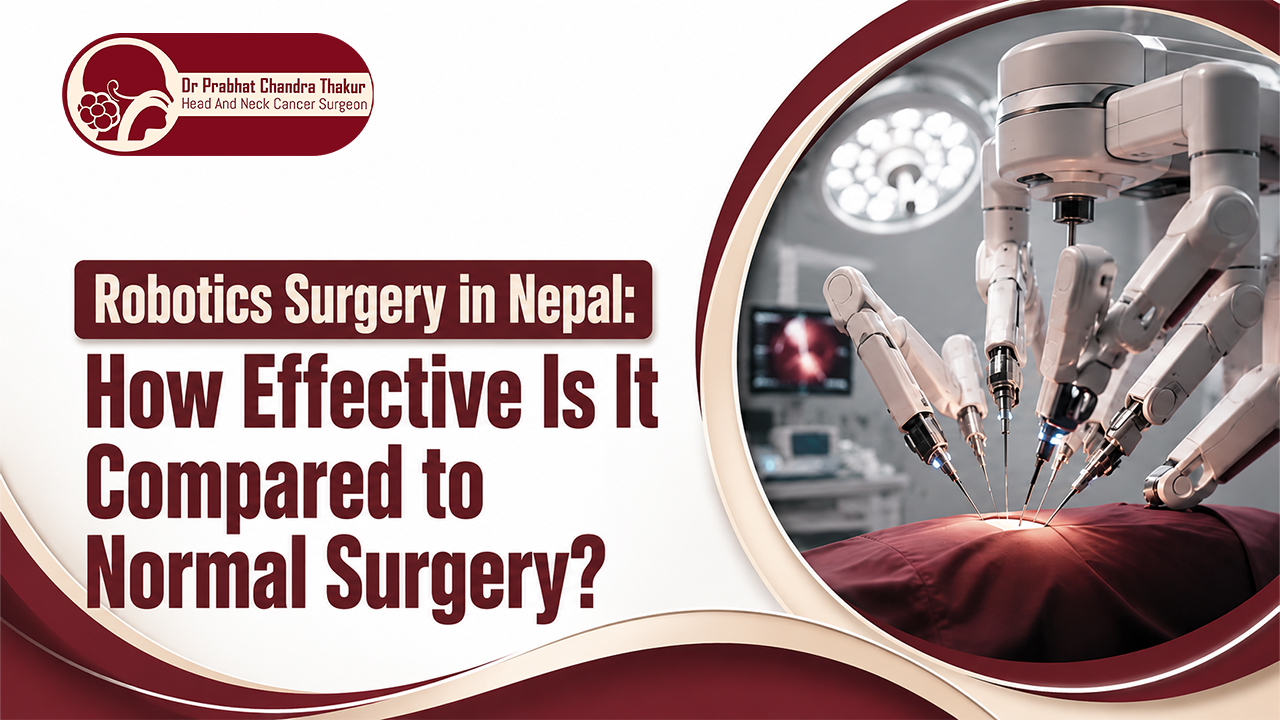
Robotics surgery in Nepal is an emerging topic for patients who want to understand whether advanced surgical technology can make operations safer, more precise, and easier to recover from. In simple words, robotic surgery is a type of minimally invasive surgery where the surgeon controls robotic instruments through a console. The robot does not operate by itself. The surgeon remains fully in control throughout the procedure.
For ENT, thyroid, head and neck, and cancer related conditions, robotic and endoscopic surgical techniques may help in selected patients. However, robotic surgery is not automatically better for everyone. The right approach depends on the disease, stage, location, patient’s health, surgeon’s expertise, available technology, and expected benefit.
This article explains what robotic surgery means, how it differs from conventional surgery, where it may be useful, and what patients in Nepal should ask before choosing it.
Medical note: This article is for educational purposes only. It should not replace consultation with a qualified surgeon, ENT doctor, or cancer specialist.
What Is Robotics Surgery?
Robotics surgery in Nepal refers to the use of robotic assisted surgical systems to help doctors perform operations through small openings or hidden access routes. In many cases, robotic surgery is part of a broader category called minimally invasive surgery.
A robotic system usually includes:
| Component | What It Does |
| Surgeon console | The surgeon controls the instruments from here |
| Robotic arms | Hold and move surgical instruments |
| Camera system | Gives a magnified view of the surgical field |
| Surgical instruments | Cut, dissect, grasp, and stitch tissues |
| Operating team | Assists with anesthesia, instruments, monitoring, and patient safety |
The important point is this: robotic surgery is surgeon controlled surgery. It is not automatic surgery.
The surgeon’s training, experience, and judgment remain more important than the machine itself.
Why Are Patients Talking About Robotic Surgery?
Patients are interested in robotic surgery because it is often associated with smaller cuts, better A more accurate answer is:
Robotic surgery can be useful in selected patients, but it is not necessary or suitable for every disease.
For thyroid, head and neck, and ENT conditions, the decision should be based on medical need, anatomy, diagnosis, safety, cancer principles, and surgeon expertise.
Robotics Surgery vs Normal Surgery: What Is the Difference?
Normal surgery usually means open surgery, where the surgeon makes an incision to directly reach the organ or tumor. Robotic surgery uses robotic instruments controlled by the surgeon, usually through smaller or hidden incisions.
| Feature | Open Surgery | Robotic Surgery |
| Incision | Usually larger and direct | Smaller or hidden access in selected cases |
| View | Direct surgical view | Magnified 3D camera view |
| Instrument movement | Surgeon’s hands directly | Surgeon controls robotic arms |
| Recovery | Depends on procedure | May be faster in selected cases |
| Pain | Depends on incision and surgery type | May be less in some minimally invasive procedures |
| Scar | Usually visible at incision site | May be smaller or hidden depending on approach |
| Cost | Often lower | Often higher due to technology |
| Suitability | Suitable for many cases | Suitable only for selected patients |
| Safety | Depends on surgeon and case | Depends on surgeon, case, and technology |
Neither method is “always best.” A safe open surgery is better than an inappropriate robotic surgery.
How Effective Is Robotic Surgery?
Robotic surgery can be effective when the patient is properly selected and the surgeon is trained in that specific procedure. Its main value is not that it is “modern,” but that it can improve access, visualization, precision, and cosmetic outcomes in certain operations.
For thyroid surgery, several approaches exist. Mayo Clinic notes that thyroidectomy may be performed through conventional neck incision, transoral access through the mouth, or endoscopic approaches using smaller incisions and camera guidance.
In selected thyroid cases, remote-access or scarless techniques can reduce visible neck scarring. However, these approaches also require special training, careful patient selection, and a clear understanding of risks.
A medical review on transoral endoscopic thyroidectomy vestibular approach reported that TOETVA can provide excellent cosmetic results and similar complication rates to standard open thyroidectomy in selected cases, while also noting that larger studies are needed to compare long-term quality of life, voice outcomes, and cancer-related outcomes.
So, robotic or scarless surgery can be helpful, but it should not be treated as a marketing label.
What Are the Benefits of Robotic Surgery?
Robotic surgery may offer several benefits in selected patients.
| Possible Benefit | What It Means for Patients |
| Smaller or hidden incision | Less visible scarring in some procedures |
| Better visualization | Magnified camera view helps the surgeon see small structures |
| Greater precision | Robotic instruments may allow refined movements |
| Less tissue handling | May reduce trauma in some procedures |
| Faster recovery | Possible in selected minimally invasive operations |
| Better cosmetic outcome | Especially relevant in neck and thyroid surgery |
| Access to difficult areas | May help in selected head and neck cases |
These benefits are not guaranteed. They depend on the operation type, surgeon experience, patient condition, and disease stage.
What Are the Limitations of Robotic Surgery?
Robotic surgery also has limitations.
| Limitation | Why It Matters |
| Not suitable for all patients | Large tumors, advanced cancer, or complex anatomy may need open surgery |
| Higher cost | Robotic systems and instruments can increase expenses |
| Requires trained team | Surgeon and operating room team need specific expertise |
| Longer setup time | Some robotic procedures may take longer |
| Technology dependence | Equipment availability matters |
| Different risk profile | Some approaches have unique risks |
| Cancer safety must come first | Cosmetic benefit should not compromise cancer treatment |
For thyroid surgery, the American Thyroid Association states that surgery may be needed for suspicious thyroid nodules, thyroid cancer, large goiter causing swallowing or breathing problems, and certain types of hyperthyroidism. The reason for surgery helps decide the type of operation needed.
This is why patients should ask: “Is robotic surgery medically appropriate for my case?” rather than only asking, “Is robotic surgery available?”
Is Robotic Surgery Useful for Thyroid Surgery?
Robotic and endoscopic techniques may be useful in selected thyroid operations, especially when avoiding a visible neck scar is important.
Traditional thyroid surgery usually involves a small incision in the lower front of the neck. In many patients, this heals well and becomes less noticeable over time. Mayo Clinic notes that the incision can often be placed in a natural skin crease where it is harder to see after healing.
Scarless or remote-access thyroid approaches may include:
| Approach | Access Route |
| Transoral thyroidectomy | Through an incision inside the mouth |
| Endoscopic thyroidectomy | Small incisions with camera assistance |
| Robotic thyroidectomy | Robotic-assisted instruments through selected access routes |
| Transaxillary approach | Access through the armpit area |
| BABA approach | Access through axillo-breast route |
The American Thyroid Association lists total thyroidectomy, thyroid lobectomy, and isthmusectomy as common thyroid surgery types. It also notes that lymph node surgery may be needed in thyroid cancer when lymph nodes are involved.
The surgical approach should never be chosen only for cosmetic reasons. For thyroid cancer, cancer clearance and nerve safety are more important than scar location.
When Should You Consult a Thyroid Surgeon in Nepal?
You should consult a thyroid surgeon in Nepal if you have a thyroid lump, suspicious thyroid ultrasound, abnormal biopsy, large goiter, difficulty swallowing, breathing difficulty, voice change, or confirmed thyroid cancer.
Common reasons for thyroid surgery include:
| Condition | Why Surgery May Be Considered |
| Suspicious thyroid nodule | To remove and confirm disease |
| Confirmed thyroid cancer | To treat cancer and assess spread |
| Large goiter | If it causes pressure, swallowing, or breathing problems |
| Hyperthyroidism | In selected cases not controlled by medicine or iodine |
| Recurrent cyst or nodule | If symptoms or suspicion persists |
| Neck lymph node involvement | May require thyroid and neck surgery |
In Nepal, estimated GLOBOCAN 2022 data reported 710 new thyroid cancer cases and 171 thyroid cancer deaths, with thyroid cancer ranking 8th among listed cancers by new cases in the country.
This does not mean every thyroid lump is cancer. Most thyroid nodules are benign. But suspicious nodules should be evaluated properly.
What Is the Role of an ENT Doctor in Nepal in Robotic and Thyroid Surgery?
An ENT doctor in Nepal who specializes in head and neck surgery may evaluate diseases of the throat, voice box, thyroid, salivary glands, oral cavity, neck masses, and head and neck cancers.
ENT and head-neck surgeons are often involved in:
| Area | Examples |
| Thyroid surgery | Thyroid nodules, goiter, thyroid cancer |
| Head and neck cancer | Oral, laryngeal, pharyngeal, salivary gland cancers |
| Voice-related problems | Vocal cord evaluation and care |
| Neck masses | Lymph nodes, cysts, tumors |
| Skull base and sinus surgery | Endoscopic ENT procedures |
| Reconstructive surgery | After cancer removal |
Dr. Prabhat Chandra Thakur is an ENT specialist, head and neck oncosurgeon, and thyroid surgeon based in Kathmandu, Nepal. His listed areas include oral cancer surgery, thyroid and parathyroid surgery, head and neck cancer surgery, endoscopic skull base surgery, endoscopic thyroidectomy, and reconstructive head and neck surgery.
His profile also lists training in otolaryngology-head and neck surgery, head and neck oncology, and minimally invasive thyroid surgery.
Is Robotic Surgery Better Than Open Surgery for Thyroid Cancer?
Not always.
For thyroid cancer, the main goals are:
- Remove the cancer safely
- Protect the voice nerves
- Preserve parathyroid glands when possible
- Remove involved lymph nodes when needed
- Support accurate staging and follow-up
- Maintain long-term disease control
A robotic or scarless approach may be considered only if these goals can be met safely.
For some patients, open surgery remains the safest and most appropriate option. This may include larger tumors, invasive cancers, bulky lymph nodes, previous neck surgery, complex anatomy, or when wide exposure is needed.
For selected low-risk cases, minimally invasive or remote-access surgery may be discussed. The decision should be made after ultrasound, biopsy, thyroid function tests, vocal cord assessment when needed, and full surgical evaluation.
Who May Be a Candidate for Robotic or Scarless Thyroid Surgery?
A patient may be considered for robotic or scarless thyroid surgery if the condition is suitable and the surgeon has the required expertise.
Possible candidates may include selected patients with:
| Possible Candidate Factor | Why It Matters |
| Small thyroid nodule | Easier and safer minimally invasive access |
| Benign thyroid disease | May be appropriate in selected cosmetic cases |
| Early thyroid cancer | Only when cancer principles are not compromised |
| No major lymph node disease | Complex neck dissection may need open access |
| No major previous neck surgery | Scar tissue can make surgery harder |
| Strong concern about visible neck scar | Cosmetic preference may matter |
| Good general health | Anesthesia and recovery safety matter |
Patients who may not be suitable include those with advanced cancer, very large goiter, extensive lymph node disease, invasive tumor, or anatomy that makes remote-access surgery unsafe.
What Tests Are Needed Before Thyroid or Robotic Surgery?
Before deciding on any thyroid surgery, a proper workup is needed.
| Test | Purpose |
| Neck ultrasound | Checks thyroid nodule size, features, and lymph nodes |
| Thyroid function test | Measures hormone status |
| FNAC/biopsy | Helps identify suspicious or cancerous nodules |
| CT/MRI | Used in selected large, deep, or cancer cases |
| Vocal cord examination | Important if voice symptoms or cancer suspicion exists |
| Calcium/Vitamin D tests | May help in surgical planning |
| General anesthesia evaluation | Checks fitness for surgery |
A patient should not choose robotic surgery before diagnosis is clear.
Technology should follow diagnosis, not replace it.
What Are the Risks of Thyroid Surgery?
All thyroid surgery has possible risks, whether open, endoscopic, or robotic.
| Possible Risk | Explanation |
| Voice change | Can occur if vocal cord nerves are irritated or injured |
| Low calcium | Can happen if parathyroid glands are affected |
| Bleeding | Rare but important after neck surgery |
| Infection | Possible in any surgery |
| Scar-related issues | More relevant in open neck incision |
| Swallowing discomfort | Usually temporary but should be monitored |
| Need for thyroid hormone | Especially after total thyroidectomy |
| Need for further treatment | Some cancer cases need radioactive iodine or follow-up therapy |
The American Thyroid Association notes that total thyroidectomy removes the entire thyroid gland and usually requires lifelong thyroid hormone replacement afterward.
Patients should discuss these risks clearly before surgery.
Does Robotic Surgery Mean Faster Recovery?
Sometimes, but not always.
Recovery depends on the disease, operation type, anesthesia duration, incision route, patient age, general health, and complications.
In some minimally invasive operations, patients may experience less visible scarring, less wound discomfort, and earlier return to routine activities. But robotic surgery can also involve longer operating time or unique discomfort depending on the access route.
A balanced expectation is better than a promise.
Ask your surgeon:
| Question | Why It Helps |
| How long will I stay in the hospital? | Helps plan recovery |
| When can I eat normally? | Important after neck or throat surgery |
| When can I return to work? | Depends on surgery type |
| Will my voice be checked? | Important after thyroid surgery |
| Do I need calcium tablets? | May be needed after thyroid surgery |
| Will I need thyroid hormone? | Important after total thyroidectomy |
| What warning signs should I watch for? | Supports safe recovery |
What Should Patients Ask Before Choosing Robotics Surgery in Nepal?
Before choosing robotics surgery in Nepal, ask these questions:
- Is robotic surgery suitable for my diagnosis?
- What are the alternatives?
- Is open surgery safer in my case?
- What are the risks specific to this approach?
- How many similar procedures has the surgeon performed?
- Will cancer clearance be equal to standard surgery?
- What will happen if robotic surgery cannot be completed?
- What is the expected cost difference?
- Will I need further treatment after surgery?
- What follow-up is required?
These questions protect patients from choosing surgery based only on technology or appearance.
Robotics Surgery in Nepal for Head and Neck Conditions
Robotic surgery may be discussed in selected head and neck conditions, especially where access is difficult with traditional tools. In some countries, robotic approaches are used for selected throat, tonsil, base-of-tongue, and thyroid procedures.
However, head and neck cancers are complex. Surgery must consider speech, swallowing, breathing, appearance, lymph nodes, reconstruction, and cancer control.
A thyroid cancer specialist in Nepal or head and neck oncosurgeon may recommend open, endoscopic, robotic, or combined treatment depending on the case.
Treatment may also involve:
| Treatment | When It May Be Needed |
| Surgery | To remove tumor or thyroid disease |
| Neck dissection | If lymph nodes are involved |
| Radioactive iodine | In selected thyroid cancer cases |
| Radiation therapy | In selected head and neck cancers |
| Chemotherapy | In some advanced cancer cases |
| Targeted therapy | In selected cancers |
| Voice/swallow therapy | After certain surgeries |
| Reconstruction | After larger tumor removal |
The right treatment plan is usually multidisciplinary.
Cost Considerations of Robotic Surgery
Robotic surgery can be more expensive than conventional surgery because of equipment, maintenance, disposable instruments, operating time, and specialized training.
Patients should ask for a clear cost breakdown, including:
| Cost Area | What to Clarify |
| Surgeon fee | Included or separate |
| Hospital charge | Room, OT, nursing |
| Robotic equipment cost | Whether separate |
| Anesthesia fee | Included or separate |
| Lab and imaging | Before and after surgery |
| Medicines | Pain, antibiotics, calcium, thyroid hormone |
| Follow-up | Visits and tests |
| Further treatment | Radiation, iodine, or oncology care if needed |
Cost should not be the only deciding factor. But patients deserve transparent information.
How to Choose the Right Surgeon
Technology is important, but the surgeon is more important.
When choosing a thyroid surgeon in Nepal, ENT doctor in Nepal, or thyroid cancer specialist in Nepal, consider:
| Factor | Why It Matters |
| Relevant training | Thyroid, ENT, head and neck oncology experience |
| Case experience | Familiarity with similar conditions |
| Cancer care knowledge | Important for thyroid and head-neck cancers |
| Access to hospital support | ICU, anesthesia, pathology, imaging |
| Multidisciplinary team | Needed for cancer care |
| Communication | Clear explanation reduces fear |
| Follow-up system | Surgery is not the final step |
| Honest risk discussion | Builds trust |
A good surgeon will explain both the benefits and limits of robotic surgery.
Common Myths About Robotic Surgery
Myth 1: The robot performs the surgery by itself.
No. The surgeon controls the robotic system.
Myth 2: Robotic surgery is always better than open surgery.
No. It is better only when it is appropriate for the patient and disease.
Myth 3: Robotic surgery has no risks.
No surgery is risk-free. Robotic surgery has general surgical risks and approach-specific risks.
Myth 4: Scarless surgery means minor surgery.
Not always. The incision may be hidden, but the internal operation can still be complex.
Myth 5: Robotic surgery is only for rich patients.
Cost is one factor, but medical suitability matters more. In some cases, standard surgery may be the better choice even if robotic surgery is available.
Direct Answer: Is Robotics Surgery in Nepal Worth It?
Robotics surgery in Nepal may be worth considering if it offers a clear medical or cosmetic benefit without compromising safety. It can be useful for selected thyroid, ENT, and head and neck cases when performed by a trained surgeon with proper hospital support.
However, patients should avoid choosing robotic surgery only because it sounds advanced. The best surgery is the one that treats the disease safely, preserves function, minimizes complications, and fits the patient’s individual condition.
About Dr. Prabhat Chandra Thakur
Dr. Prabhat Chandra Thakur is an ENT specialist, head and neck oncosurgeon, and thyroid surgeon based in Kathmandu, Nepal. His clinical areas include oral cancer surgery, thyroid and parathyroid surgery, head and neck cancer surgery, endoscopic skull base surgery, endoscopic thyroidectomy, and reconstructive head and neck surgery.
His listed qualifications include MBBS from B.P. Koirala Institute of Health Sciences, MS in Otolaryngology-Head and Neck Surgery from PGI Chandigarh, fellowship in head and neck oncology, and fellowship training in minimally invasive thyroid surgery.
FAQs About Robotics Surgery in Nepal
What is robotics surgery in Nepal?
Robotics surgery in Nepal means surgeon-controlled surgery using robotic instruments and camera systems. The robot does not operate independently.
Is robotic surgery safer than normal surgery?
It can be safe in selected patients, but it is not automatically safer for everyone. Safety depends on the disease, patient selection, surgeon training, and hospital support.
Is robotic surgery available for thyroid surgery?
Robotic and endoscopic thyroid surgery may be considered in selected thyroid cases. However, conventional thyroid surgery remains appropriate for many patients.
Who is the right doctor for thyroid surgery?
A qualified thyroid surgeon in Nepal, ENT head and neck surgeon, or thyroid cancer specialist in Nepal can evaluate thyroid nodules, goiter, and thyroid cancer.
Does robotic thyroid surgery leave no scar?
Some remote-access and transoral approaches may avoid a visible neck scar. However, not every patient is suitable for scarless surgery.
Is open thyroid surgery outdated?
No. Open thyroid surgery remains a standard, safe, and widely used approach. In many cases, it may be the best option.
Is robotic surgery painful?
Pain varies by operation. Some minimally invasive procedures may cause less wound pain, but recovery depends on the surgery type and patient condition.
Can thyroid cancer be treated with robotic surgery?
Selected low-risk thyroid cancer cases may be considered for minimally invasive approaches, but cancer safety is the priority. Some thyroid cancers require open surgery and lymph node management.
What should I ask before robotic surgery?
Ask whether it is suitable for your diagnosis, what the risks are, what alternatives exist, how experienced the surgeon is, and whether the same cancer safety can be achieved.
Conclusion
Robotics surgery in Nepal is an important development in modern surgical care, but it should be understood carefully. It is not magic, and it is not automatically better than normal surgery.
For selected patients, robotic and minimally invasive approaches may offer benefits such as smaller or hidden scars, better visualization, and faster recovery. For others, open surgery may be safer, more practical, and more effective.
If you have a thyroid lump, thyroid cancer, neck mass, throat problem, or head and neck condition, consult a qualified ENT doctor in Nepal or thyroid surgeon in Nepal. The best decision should be based on diagnosis, safety, surgeon expertise, and long-term outcome not just the name of the technology.