
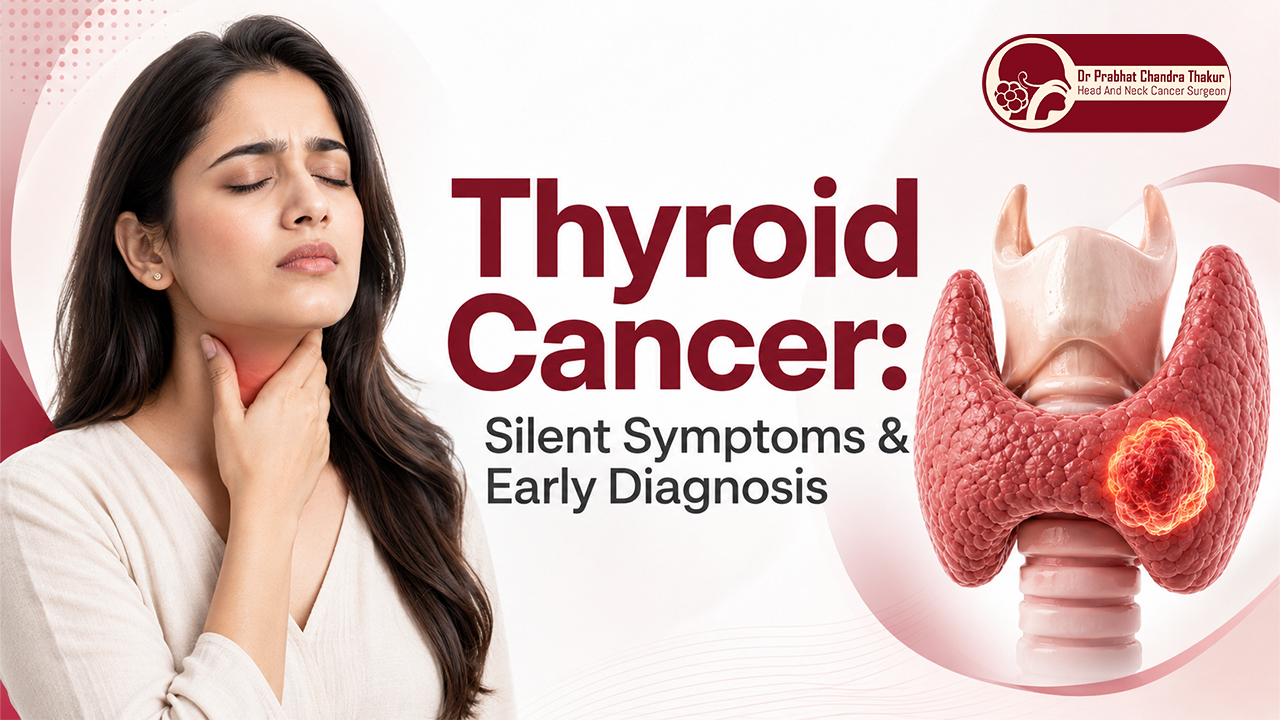
Thyroid cancer does not always cause symptoms in the early stage. Many people feel completely normal until a thyroid nodule is found during a routine neck examination, health checkup, or ultrasound done for another reason.
This is why small neck changes should not be ignored.
A painless lump in the front of the neck, swelling, persistent voice change, difficulty swallowing, breathing discomfort, or a lump on the side of the neck can be warning signs. The American Cancer Society lists these as possible signs and symptoms of thyroid gland cancer, while also noting that many thyroid lumps are not cancer.
Early diagnosis matters because many thyroid cancers, especially common differentiated types, are highly treatable when found early. However, proper evaluation by a thyroid cancer specialist or thyroid surgeon is important to avoid both delayed diagnosis and unnecessary treatment.
What Is Silent Thyroid Cancer?
Silent cancer of thyroid means cancer in the thyroid gland that causes no obvious symptoms at first.
The thyroid is a small butterfly-shaped gland in the front of the neck. It produces hormones that help control metabolism, energy use, heart rate, and body temperature.
Thyroid malignancy may begin as a small nodule. Some nodules are discovered when a doctor examines the neck. Others are found during ultrasound, CT scan, MRI, or other imaging tests done for unrelated reasons.
Cancers arising in thyroid nodules generally do not cause symptoms, and thyroid function tests are typically normal even when cancer is present.
This is one reason many patients are surprised when cancer is detected despite having normal thyroid hormone reports.
Why Can Thyroid Cancer Be Silent?
Early stage thyroid cancer can be silent because early tumors may be small, slow-growing, and not large enough to press on nearby structures.
The thyroid gland is located near the windpipe, food pipe, voice box nerves, and neck lymph nodes. Symptoms usually appear when a nodule becomes large, affects nearby tissues, or spreads to lymph nodes.
Many early nodules do not disturb hormone production. That means a person may have normal TSH, T3, and T4 levels.
This does not mean blood tests are useless. It means blood tests are only one part of evaluation.
Thyroid Cancer Symptoms: What Should You Watch For?
Early disease may have no symptoms. When symptoms appear, they often involve the neck, voice, swallowing, or breathing.
Common thyroid cancer symptoms
| Symptom | What it may mean |
| Lump in the front of the neck | A thyroid nodule or enlarged thyroid |
| Swelling in the neck | Thyroid growth or lymph node swelling |
| Hoarseness or voice change | Possible irritation or pressure near voice nerves |
| Trouble swallowing | Pressure on the food pipe |
| Trouble breathing | Pressure on the windpipe |
| Persistent cough | Cough not explained by cold or allergy |
| Neck pain | Pain may spread toward the ears |
| Lump on the side of the neck | Possible enlarged lymph node |
Medical evaluation for these symptoms because they may be caused by benign conditions, other neck problems, or thyroid tumor.
The key point is simple: symptoms do not confirm cancer, but persistent symptoms deserve a doctor’s evaluation.
Can Routine Checkups Detect Thyroid Cancer Early?
Yes. Routine checkups can help detect thyroid cancer early, especially when a doctor feels the neck and identifies a nodule, swelling, or enlarged lymph node.
Many thyroid nodules are found incidentally during imaging. This may happen during:
- Neck ultrasound
- Carotid Doppler ultrasound
- CT scan of the neck or chest
- MRI for spine or neck problems
- PET scan for another medical reason
- General health checkups
The American Thyroid Association describes thyroid ultrasound as a key tool for thyroid nodule evaluation because it can determine whether a nodule is solid or fluid-filled and identify features that may look suspicious.
Not every small nodule needs biopsy or surgery. A good evaluation separates low-risk nodules from nodules that need further testing.
Can a Routine Blood Test Detect Thyroid Cancer?
Usually, no.
Routine thyroid blood tests such as TSH, T3, and T4 check thyroid function. They do not reliably detect most thyroid cancers.
The American Cancer Society notes that TSH, T3, and T4 levels are usually normal in people with thyroid cancer. Thyroglobulin is not used to diagnose thyroid cancer but can be useful after treatment, while calcitonin may help when medullary thyroid cancer is suspected.
Blood tests vs imaging
| Test | Can it detect most thyroid cancers? | Main use |
| TSH | No | Checks thyroid activity |
| T3/T4 | No | Checks thyroid hormone levels |
| Thyroglobulin | No for initial diagnosis | Follow-up after treatment |
| Calcitonin | Sometimes | Helps assess suspected medullary thyroid cancer |
| Ultrasound | Helps detect suspicious nodules | First-line imaging test |
| FNAC/biopsy | Yes, when diagnostic | Confirms suspicious cells |
So, a normal thyroid blood report does not always rule out thyroid cancer.
What Usually Happens During Thyroid Cancer Diagnosis?
Diagnosis usually starts with a medical history and physical examination.
A doctor checks the neck, thyroid gland, lymph nodes, voice symptoms, swallowing symptoms, family history, previous radiation exposure, and other risk factors.
If a nodule is suspected, ultrasound is often recommended.
Ultrasound can show whether a thyroid nodule is solid or fluid-filled, measure its size, evaluate nearby lymph nodes, and guide biopsy for nodules that are too small or difficult to feel.
Typical diagnostic pathway
| Step | What happens |
| Clinical examination | Doctor checks thyroid, neck, lymph nodes, voice symptoms |
| Thyroid blood tests | TSH and related tests assess thyroid function |
| Ultrasound | Evaluates nodule size, structure, and suspicious features |
| FNAC/biopsy | Fine needle sample is tested under microscope |
| Laryngoscopy | May be done if voice change or surgery planning is needed |
| CT/MRI | Used in selected cases to assess spread or complex disease |
| Molecular testing | Used in selected indeterminate or advanced cases |
The National Cancer Institute also lists thyroid, neck, blood tests, laryngoscopy, ultrasound, CT scan, and other tests as part of thyroid cancer diagnosis and evaluation.
How Long Does It Take to Diagnose Thyroid Cancer?
The time depends on symptoms, appointment availability, imaging access, biopsy scheduling, and pathology reporting.
In many cases, evaluation may start within days after a neck lump or ultrasound finding is noticed. Diagnosis may take longer if the nodule is small, results are unclear, or repeat biopsy is needed.
A practical timeline may look like this:
| Stage | Approximate process |
| First consultation | Neck exam and history |
| Ultrasound | Same day or scheduled soon, depending on facility |
| FNAC/biopsy | Done if the nodule meets criteria |
| Pathology report | Usually takes several days, sometimes longer |
| Treatment planning | Based on diagnosis, stage, and patient health |
Some thyroid nodules are monitored rather than biopsied immediately. This does not always mean delay. It may be the safest evidence-based approach when the nodule appears low risk.
Is Thyroid Cancer Curable If Caught Early?
Many thyroid cancers are highly treatable when detected early, especially papillary and follicular thyroid cancers.
U.S. SEER data reports a 99.9% five-year relative survival rate for localized thyroid cancer, meaning cancer confined to the primary site. This statistic is based on U.S. population data and may not directly represent every country or individual patient, but it shows why early diagnosis is important.
Treatment outcome depends on:
- Type of thyroid cancer
- Stage at diagnosis
- Age and general health
- Tumor size
- Lymph node involvement
- Spread outside the thyroid
- Surgical completeness
- Response to radioactive iodine, when used
- Follow-up care
Early detection does not remove the need for expert treatment. It improves the chance of a simpler, more controlled treatment plan.
Types of Thyroid Cancer
Different thyroid cancers behave differently. Treatment is not the same for everyone.
| Type | General behavior |
| Papillary thyroid cancer | Most common; often slow-growing |
| Follicular thyroid cancer | Can spread through blood in some cases |
| Medullary thyroid cancer | May be linked with genetic syndromes |
| Anaplastic thyroid cancer | Rare but aggressive |
| Hurthle cell thyroid cancer | A subtype with specific management needs |
Because the type matters, biopsy and pathology are essential.
A thyroid lump cannot be classified accurately by touch alone.
Thyroid Cancer Treatment: What Are the Main Options?
Thyroid cancer treatment depends on the cancer type, stage, size, lymph node involvement, and patient factors.
Common options include:
| Treatment | Purpose |
| Thyroid lobectomy | Removes one thyroid lobe in selected cases |
| Total thyroidectomy | Removes the whole thyroid gland |
| Lymph node surgery | Removes involved neck lymph nodes when needed |
| Radioactive iodine therapy | Used for selected differentiated thyroid cancers |
| Thyroid hormone therapy | Replaces hormone and may suppress TSH when needed |
| External beam radiation | Used in selected advanced or high-risk cases |
| Targeted therapy | Used for selected advanced cancers with specific mutations |
| Active surveillance | Used for carefully selected very low-risk cases |
Surgery is a standard treatment for many primary thyroid cancers, with surgical options including lobectomy or total thyroidectomy depending on factors such as patient age and nodule size.
A qualified thyroid surgeon helps decide whether surgery is necessary, what extent of surgery is appropriate, and how to reduce risks such as voice nerve injury, calcium imbalance, bleeding, or scar-related concerns.
When Should You See a Thyroid Cancer Specialist?
You should consult a thyroid cancer specialist or thyroid surgeon if you have:
- A thyroid nodule found on ultrasound
- A neck lump that does not go away
- Hoarseness lasting more than a few weeks
- Difficulty swallowing
- Difficulty breathing
- Enlarged lymph nodes in the neck
- Family history of thyroid cancer
- Previous radiation exposure to the head or neck
- Suspicious FNAC or biopsy report
- Recurrent thyroid swelling after previous treatment
A specialist can review imaging, decide whether biopsy is needed, explain treatment choices, and plan safe follow-up.
Why Small Symptoms Should Not Be Ignored
Many patients delay consultation because the swelling is painless, small, or not causing discomfort.
This is understandable. Many thyroid nodules are benign. Most thyroid nodules are benign, while a small percentage are cancer.
Still, “probably benign” should not become “never checked.”
A painless neck lump can still need evaluation. Voice change may be related to infection, allergy, reflux, vocal cord strain, or thyroid disease. Swallowing difficulty may have many causes.
The goal of consultation is not to create fear. It is to separate harmless conditions from those needing treatment.
Routine Ultrasound: Helpful but Not Always Necessary for Everyone
Ultrasound is useful when there is a neck lump, abnormal examination, suspicious symptom, known thyroid nodule, or follow-up need.
However, routine ultrasound screening for everyone is not always recommended because it may find very small low-risk nodules that may never cause harm. This can lead to anxiety, repeat tests, and unnecessary treatment.
The best approach is risk-based evaluation.
Who may need closer evaluation?
| Higher-risk situation | Why it matters |
| Childhood head or neck radiation | Increases thyroid cancer risk |
| Family history of thyroid cancer | May indicate inherited risk |
| Fast-growing neck lump | Needs prompt evaluation |
| Hoarseness with thyroid swelling | May suggest nerve involvement |
| Enlarged side-neck lymph node | Needs assessment |
| Prior thyroid cancer | Requires follow-up |
| Suspicious ultrasound features | May need FNAC |
A doctor can decide whether ultrasound, FNAC, observation, or surgery is appropriate.
Thyroid Nodules: Cancer or Not?
A thyroid nodule is a lump or growth in the thyroid gland.
Most nodules are not cancerous. Some are cysts, benign overgrowths, inflammatory nodules, or hormone-producing nodules.
The challenge is identifying the small percentage that may be cancerous.
Benign vs suspicious features
| More reassuring features | More concerning features |
| Pure fluid-filled cyst | Solid hypoechoic nodule |
| Smooth margins | Irregular margins |
| No suspicious lymph nodes | Enlarged abnormal lymph nodes |
| Stable size over time | Rapid growth |
| No symptoms | Persistent hoarseness or swallowing difficulty |
This table is educational only. Ultrasound interpretation should be done by trained clinicians.
What Is the Biggest Indicator of Thyroid Cancer?
There is no single symptom that confirms thyroid cancer.
The strongest concern usually comes from a combination of clinical findings and ultrasound features.
A suspicious thyroid nodule on ultrasound, especially with abnormal neck lymph nodes, persistent hoarseness, rapid growth, or concerning biopsy results, needs careful evaluation.
FNAC or biopsy is usually needed to confirm diagnosis.
Can Thyroid Cancer Go Undiagnosed for Years?
Yes, some slow-growing thyroid cancers can remain undiagnosed for years because they may not cause symptoms.
This is especially true for small papillary thyroid cancers.
However, not all thyroid cancers are slow. Some types can grow or spread faster. Persistent symptoms should be checked rather than watched indefinitely.
A safe rule is: any neck lump, swelling, voice change, or swallowing difficulty that persists should be medically evaluated.
What Patients in Nepal Should Know
In Nepal, many patients delay care because they think a painless neck swelling is harmless or because they first try home remedies.
Another common issue is confusion between thyroid hormone disease and thyroid cancer.
Having thyroid disease does not automatically mean cancer. Having a normal thyroid hormone report does not always rule out cancer.
That is why expert neck examination and ultrasound-based evaluation are important when symptoms or nodules are present.
Dr. Prabhat Chandra Thakur is an ENT, Head & Neck Surgeon/Oncosurgeon with expertise in oral cancer, thyroid surgery, head and neck cancer, endoscopic skull base surgery, and reconstruction at Nepal Cancer Hospital & Research Center, Harisiddhi, Lalitpur.
His site also lists training in ENT and head and neck surgery, head and neck oncology fellowship exposure, and minimally invasive thyroid surgery fellowship training.
How to Prepare for a Thyroid Specialist Consultation

Before visiting a thyroid surgeon, bring:
- Previous ultrasound reports
- Blood test reports such as TSH, T3, T4
- FNAC or biopsy report, if done
- CT, MRI, or PET scan reports, if available
- List of current medicines
- Family history of thyroid cancer or endocrine tumors
- Notes about symptoms and duration
Helpful questions to ask:
- Does my thyroid nodule look suspicious?
- Do I need FNAC?
- Is observation safe in my case?
- What type of surgery is recommended?
- Will my voice be affected?
- Will I need thyroid hormone medicine lifelong?
- Do I need radioactive iodine?
- How often should I follow up?
Clear communication helps patients make informed decisions.
Practical Takeaway
Thyroid cancer can be silent. A person may have no pain, no hormone imbalance, and no obvious illness.
Routine neck examination and ultrasound can detect thyroid nodules early, especially when symptoms are mild or absent.
But early detection must be balanced with proper medical judgment. Not every thyroid nodule is cancer. Not every nodule needs surgery.
The safest approach is timely evaluation by a qualified thyroid specialist, especially if there is neck swelling, voice change, swallowing difficulty, breathing difficulty, or a suspicious ultrasound finding.
Author Bio
Dr. Prabhat Chandra Thakur is an ENT, Head & Neck Surgeon/Oncosurgeon and thyroid surgeon based in Kathmandu, Nepal. His clinical work includes thyroid surgery, head and neck cancer surgery, oral cancer surgery, endoscopic skull base surgery, and reconstructive head and neck procedures.
Medical Disclaimer
This article is for educational purposes only. It does not replace consultation, diagnosis, or treatment from a qualified doctor.
If you have a neck lump, swelling, persistent voice change, difficulty swallowing, or breathing discomfort, consult a doctor or thyroid specialist for proper evaluation.
Frequently Asked Questions
Can thyroid cancer be detected early?
Yes. Thyroid cancer can be detected early through neck examination, ultrasound, and biopsy when a suspicious thyroid nodule or lymph node is found.
Can a routine blood test detect thyroid cancer?
Usually, no. TSH, T3, and T4 are often normal in thyroid cancer. Blood tests help assess thyroid function, but ultrasound and biopsy are more important for diagnosis.
How long does it take to diagnose thyroid cancer?
It varies. Diagnosis may take days to weeks depending on ultrasound, biopsy scheduling, pathology reporting, and whether repeat testing is needed.
Is thyroid cancer curable if caught early?
Many thyroid cancers are highly treatable when caught early, especially papillary and follicular thyroid cancers. Outcome depends on cancer type, stage, age, and treatment response.
What is the biggest indicator of thyroid cancer?
A suspicious thyroid nodule on ultrasound, especially with abnormal neck lymph nodes, rapid growth, persistent hoarseness, or concerning biopsy results, is a major warning sign.
How long can thyroid cancer go undiagnosed?
Some slow-growing thyroid cancers can remain undiagnosed for years because they may cause no symptoms. However, any persistent neck lump, swelling, or voice change should be checked.