
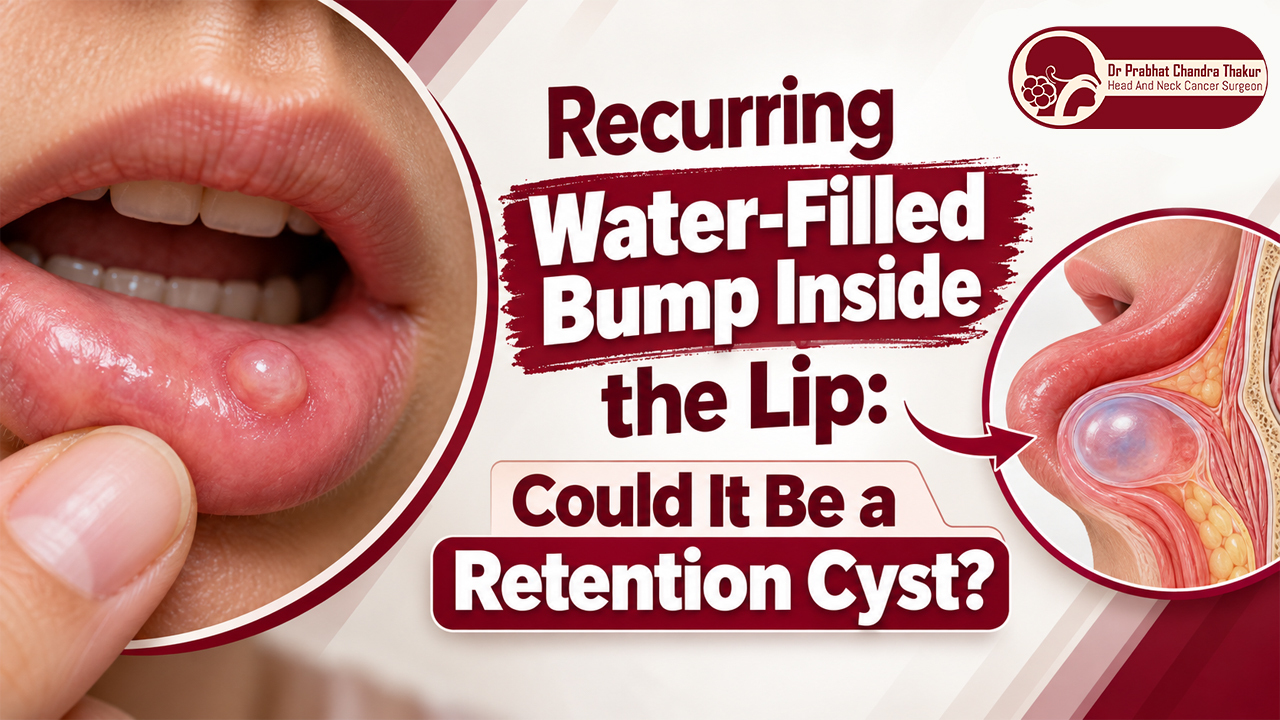
A soft, clear or bluish bump inside the lip that swells, bursts or shrinks, then fills again may be an oral mucocele, commonly described by patients as a retention cyst or mucous cyst. These lesions usually involve a minor salivary gland and are often related to lip biting, repeated irritation or disruption of a tiny salivary duct.
Most oral mucoceles are benign and painless. However, a recurrent mouth lump should not automatically be self-diagnosed. A lesion that persists, repeatedly returns, becomes firm, bleeds, ulcerates, changes appearance or interferes with eating or swallowing deserves professional assessment.
One useful point is often missed: not every so-called “retention cyst” on the lower lip is technically a true retention cyst. The more common lower-lip lesion is often a mucus-extravasation mucocele, in which saliva escapes from an injured duct into nearby tissue.
This distinction helps explain why the bump can disappear and return.
What Is a Retention Cyst Inside the Lip?
A mucus retention cyst is a mucus-containing swelling associated with a salivary duct.
Your lips and other parts of the mouth contain many small salivary glands. Each gland releases saliva through a tiny duct. If a duct becomes damaged or obstructed, mucus can accumulate and create a smooth swelling.
Patient-facing medical resources often group these lesions under terms such as:
- oral mucocele
- mucous cyst
- mucus retention cyst
- salivary mucous cyst
MedlinePlus describes an oral mucous cyst as a painless, thin sac on the inner surface of the mouth containing clear fluid. Common sites include the inner upper or lower lip and cheeks.
The lower lip is a particularly common location for mucoceles because it is easily traumatized by accidental or habitual biting.
Is a Retention Cyst the Same as a Mucocele?
The terms are often used interchangeably in everyday health information, but medically there is an important distinction.
Oral mucoceles can develop through two mechanisms.
Mucus extravasation mucocele
This happens when trauma damages a salivary duct.
Saliva then leaks out of the duct and collects within the surrounding soft tissue. Because the mucus is not enclosed by a true epithelial cyst wall, the lesion is sometimes described as a pseudocyst.
This is the more common mechanism, particularly in lower-lip mucoceles.
Mucus retention cyst
A true mucus retention cyst develops when a salivary duct becomes obstructed.
The saliva remains within the ductal system and expands it. Unlike an extravasation lesion, a true retention cyst has an epithelial lining.
StatPearls describes extravasation mucoceles as primarily trauma-related and retention mucoceles as a less common form caused by salivary-duct obstruction.
This means that the everyday phrase “retention cyst on my lip” may be understandable, but only examination—and occasionally histopathological assessment can determine the exact lesion type.
Why Does the Water-Filled Bump Keep Coming Back?
The burst–shrink–refill cycle is one of the most characteristic stories people describe with mucoceles.
A typical sequence may be:
- A minor salivary gland or duct is injured.
- Saliva accumulates beneath the lining of the lip.
- A smooth, fluid-containing bump forms.
- The thin surface breaks or the mucus drains.
- The bump becomes smaller or seems to disappear.
- The damaged gland continues producing saliva.
- Fluid accumulates again.
- The swelling returns.
MedlinePlus notes that mucoceles may break open spontaneously but can recur. Reviews of oral mucoceles also describe repeated swelling, rupture, collapse and refilling.
This explains why simply puncturing or squeezing the swelling does not necessarily solve the problem.
The underlying gland or duct may still be producing saliva.
What Does an Oral Mucocele Usually Look Like?
A typical oral mucocele may appear:
- smooth
- rounded or dome-shaped
- soft
- fluctuant or “squishy”
- clear, pink or bluish
- painless
- located inside the lower lip
The size can fluctuate over time.
Cleveland Clinic describes oral mucoceles as soft, dome-shaped lesions that are commonly clear or bluish and frequently affect the inner lower lip.
The colour partly depends on how close the collection is to the surface.
A superficial lesion may appear translucent or blue. A deeper or repeatedly traumatized lesion may appear similar in colour to normal oral tissue.
Can a mucocele feel firm?
Sometimes.
A chronic lesion can develop fibrosis or become less obviously fluid-filled, which may make it feel firmer than a newly formed superficial mucocele.
That is another reason not to rely solely on touch for diagnosis.
What Causes a Retention Cyst or Mucocele Inside the Lip?
The most common underlying issue is disruption of normal saliva flow.
Lip biting
Accidentally biting the lower lip while eating can damage a small salivary duct.
Repeated habitual lip biting may cause continuing trauma and increase the chance that a lesion returns.
Lip sucking or chewing
Some people repeatedly pull or chew on the inside of their lips without realizing it.
Chronic mechanical irritation can injure the same minor salivary glands over and over.
Other local trauma
Dental procedures, orthodontic appliances, sharp teeth or other sources of repeated local irritation may sometimes contribute to tissue trauma.
Salivary-duct obstruction
A true retention-type lesion occurs when the duct is obstructed and saliva accumulates within it.
The retention form is less common than the extravasation form.
Why the lower lip?
The lower lip contains many minor salivary glands and is particularly exposed to accidental biting and repetitive trauma.
This combination makes it a classic location for an oral mucocele.
Can Children and Teenagers Get Mucoceles?
Yes.
Mucoceles can occur at different ages and are commonly seen in younger patients, particularly when repetitive lip biting or other minor trauma is involved.
A child may repeatedly bite or play with the swelling because it feels unusual, which can maintain the cycle of trauma.
Parents should discourage biting, squeezing or puncturing the lesion.
A persistent or recurrent bump should be assessed rather than repeatedly treated at home.
Is a Retention Cyst Painful?
Most mucoceles are painless.
People commonly notice them because:
- the bump feels unusual
- it catches between the teeth
- they keep touching it with the tongue
- it repeatedly becomes larger
- it interferes with biting or chewing
Larger lesions can become uncomfortable simply because they occupy space.
If a swelling becomes acutely painful, red, hot, ulcerated or associated with pus or fever, another process such as infection or trauma may need to be considered.
Is a Retention Cyst Dangerous?
A typical oral mucocele is usually benign.
That is reassuring, but it does not mean every water-filled or painless bump in the mouth should automatically be labelled a mucocele.
Several oral conditions can produce lumps or swellings with overlapping appearances.
A clinician’s job is not only to ask, “Does this look like a mucocele?”
The more important question is:
“Is there anything about this lesion that makes another diagnosis more likely?”
That distinction is especially relevant when the lesion:
- occurs in an unusual location
- feels hard or fixed
- does not fluctuate
- ulcerates
- repeatedly bleeds
- grows progressively
- causes numbness
- is associated with a neck lump
- affects swallowing or speech
- fails to resolve as expected
What Else Can Look Like a Retention Cyst?
Several benign and less common serious conditions can resemble a mucocele.
| Condition | Possible appearance | Important distinction |
|---|---|---|
| Mucocele | Soft, clear/bluish, fluctuant swelling | Often lower lip; may shrink and refill |
| Fibroma | Firm, smooth oral lump | Usually more solid than fluid-filled |
| Venous/vascular lesion | Blue or purple swelling | Blood-vessel origin rather than saliva |
| Abscess | Swelling, often painful | May involve infection |
| Lipoma | Soft tissue lump | Fat-containing rather than mucus-filled |
| Salivary-gland tumour | Persistent lump | Requires professional evaluation |
| Oral cancer | Persistent lump, ulcer or thickening | May have red/white change, bleeding, pain or numbness |
StatPearls lists vascular lesions, fibroma, abscess, lipoma and benign or malignant salivary-gland neoplasms among conditions that may enter the differential diagnosis of oral mucus-containing swellings.
The practical message is simple:
Appearance can suggest a mucocele, but appearance alone does not prove the diagnosis.
Retention Cyst vs Oral Cancer: How Are They Different?
Most recurring, translucent lower-lip mucoceles are benign and behave very differently from typical oral malignancies.
However, no article can safely diagnose an individual oral lump.
Features more typical of a mucocele
A mucocele often:
- feels soft or fluctuant
- has a clear or bluish appearance
- occurs inside the lower lip
- follows lip trauma or biting
- changes size
- may burst
- may temporarily disappear and refill
- is usually painless
Features that deserve closer evaluation
The National Cancer Institute lists persistent sores or lumps in the mouth, white or red patches, bleeding, pain or numbness, difficulty chewing or swallowing and other persistent oral changes among possible warning signs of lip and oral-cavity cancer.
Seek professional assessment if a lesion is:
- persistently ulcerated
- hard or fixed
- progressively enlarging
- bleeding repeatedly without obvious trauma
- associated with numbness
- accompanied by a persistent red or white patch
- associated with difficulty chewing or swallowing
- accompanied by unexplained neck swelling
These signs do not mean that cancer is present.
They mean the lesion should not simply be assumed to be a harmless retention cyst.
For broader oral-cancer information, readers can review Dr. Prabhat Chandra Thakur’s guidance on persistent oral abnormalities and oral cancer.
How Does a Doctor Diagnose a Retention Cyst?
Diagnosis often begins with clinical history and examination.
A clinician may ask:
- How long has the bump been present?
- Does it disappear and return?
- Does it burst?
- Is the fluid clear or bloody?
- Have you bitten the area?
- Is it painful?
- Has its size changed?
- Have you had similar lesions before?
- Do you use tobacco?
- Is there numbness or altered sensation?
- Do you have trouble eating or swallowing?
The location and behaviour of the swelling can provide useful clues.
Physical examination
The clinician may assess:
- size
- colour
- consistency
- mobility
- whether it is fluctuant
- surrounding tissue
- teeth or appliances that may be causing trauma
- other abnormalities in the mouth and neck
Many typical mucoceles can be clinically recognized from their history and appearance.
Is imaging usually required?
Not for every small, typical lip mucocele.
Additional investigation may be considered if:
- the location is unusual
- the lesion is deep
- a ranula is suspected
- diagnosis remains uncertain
- another salivary-gland condition is possible
Ultrasound, and in selected cases CT or other imaging, can be used depending on location and clinical concern.
When is biopsy useful?
Biopsy or excisional removal may be considered when the diagnosis is uncertain or when a lesion is persistent or recurrent.
Histopathology can then show whether the lesion represents mucus extravasation, a true retention cyst or another condition.
This is particularly useful when an oral lump does not have the classic behaviour of a superficial mucocele.
Does a Retention Cyst Go Away on Its Own?
Many superficial oral mucoceles resolve spontaneously.
Merck Manual notes that many mucoceles disappear within a short period, while Cleveland Clinic and MedlinePlus similarly explain that spontaneous rupture and resolution can occur.
Observation may therefore be reasonable for a newly developed, small, typical lesion when there are no concerning features.
However, spontaneous resolution does not happen in every case.
A lesion deserves evaluation when it:
- repeatedly returns
- persists
- becomes large
- repeatedly gets caught between the teeth
- interferes with eating or speaking
- causes discomfort
- has an unusual appearance
- cannot confidently be identified as a mucocele
How Is a Recurrent Retention Cyst Treated?
Treatment depends on the lesion’s size, location, duration, recurrence pattern and diagnostic certainty.
Observation
A small, recent, typical mucocele may not require immediate treatment.
Reducing repeated trauma can help.
That may mean becoming conscious of lip-biting habits or addressing a mechanical source of irritation.
Surgical excision
Persistent or recurrent mucoceles may be surgically removed.
For recurrent lesions, removing the lesion together with associated minor salivary-gland tissue can reduce continued mucus leakage and allows tissue to be examined histologically. StatPearls identifies excision with the associated minor salivary gland as a preferred option for persistent, recurrent or symptomatic lesions.
Laser treatment
Laser removal is another technique used for selected mucoceles.
The choice depends on clinician expertise, lesion characteristics and available equipment.
Cryotherapy
Some providers may use controlled freezing to treat selected lesions. Cleveland Clinic lists cryotherapy, laser treatment and surgical excision among options for recurrent or problematic oral mucoceles.
Marsupialization or micromarsupialization
Certain larger lesions or selected pediatric lesions may be managed with techniques that create a controlled drainage pathway rather than complete excision.
Treatment should be individualized.
What about aspiration?
Simply draining or aspirating a mucocele generally does not address the damaged or obstructed gland.
StatPearls notes a higher recurrence tendency with aspiration, which is why it is not considered definitive treatment for ordinary mucoceles.
Why Can a Mucocele Return After Treatment?
Recurrence does not necessarily mean the lesion is dangerous.
Several mechanisms can explain it.
Continued lip biting
If the same area remains repeatedly traumatized, another minor salivary duct can be injured.
Remaining affected gland tissue
If mucus-producing tissue associated with a recurrent lesion remains active, another collection can form.
Incomplete treatment of the source
Draining only the visible swelling may leave the underlying cause unchanged.
Incorrect initial diagnosis
A lesion that repeatedly behaves unlike a typical mucocele deserves reassessment.
That is why persistent recurrence should trigger a fresh clinical review rather than repeated home drainage.
Should You Pop a Retention Cyst Inside Your Lip?
No. Do not intentionally puncture, cut or drain the lesion yourself.
A mucocele may burst naturally, but deliberately opening it at home can:
- injure surrounding tissue
- cause bleeding
- introduce infection
- create more trauma
- fail to treat the underlying salivary gland
- make subsequent clinical assessment more difficult
MedlinePlus specifically advises against opening an oral mucous cyst yourself because of the risk of infection and tissue damage.
If it keeps returning, proper evaluation is more useful than repeatedly popping it.
Can Salt Water, Mouthwash or Home Remedies Remove It?
No home remedy can reliably remove the underlying minor salivary gland or repair a damaged duct.
Gentle oral hygiene may keep the mouth comfortable, but this is different from treating the lesion itself.
Avoid:
- cutting it with a blade
- piercing it with a needle
- repeatedly squeezing it
- applying harsh chemicals
- burning it
- using unverified caustic remedies
Repeated irritation may worsen the trauma that contributed to the lesion.
What Is a Ranula?
A ranula is a related mucus-containing swelling that occurs on the floor of the mouth, usually in association with the sublingual salivary gland rather than the small glands of the lip.
It can appear as a bluish swelling beneath the tongue.
Ranulas are clinically different from the small mucoceles commonly seen inside the lower lip and may require different evaluation and treatment.
A large floor-of-mouth swelling that affects swallowing or breathing requires prompt medical assessment.
MedlinePlus notes that a large ranula can interfere with speech or swallowing and, when extending into the neck, can potentially compromise the airway.
When Should You See a Doctor for a Lip Cyst?
Arrange an assessment when the lesion:
- keeps returning
- persists instead of resolving
- grows larger
- becomes painful
- repeatedly bleeds
- becomes firm
- develops an ulcerated surface
- interferes with eating, talking or swallowing
- appears in an unusual location
- is associated with numbness
- is accompanied by another persistent mouth lesion
- cannot confidently be identified
A persistent lump does not automatically mean cancer.
It simply means that the safest next step is to establish what the lesion actually is.
Seek prompt care for breathing or major swallowing difficulty
A rapidly enlarging floor-of-mouth or neck swelling associated with trouble breathing requires urgent medical assessment.
That situation is different from the usual small lower-lip mucocele.
Should Tobacco Users Treat a Persistent Lip Bump Differently?
A recurrent clear mucocele can still be benign in someone who uses tobacco.
However, persistent oral abnormalities deserve particular attention when combined with tobacco or smokeless-tobacco exposure because tobacco is a major risk factor for oral malignancy.
Do not assume that a lump is harmless simply because it is painless.
NCI notes that oral-cavity cancers can present with a persistent sore, lump, thickening, abnormal patch, bleeding, pain or numbness.
The safest approach is clinical examination when an oral lesion is persistent or atypical.
A Practical “CLEAR” Checklist for a Recurring Lip Bump
This is an educational framework, not a diagnostic scoring system.
C — Colour
Is it clear, pink or bluish like a typical superficial mucocele, or has it developed an unusual red, white, ulcerated or irregular surface?
L — Location
Is it inside the lower lip, where mucoceles are common, or in a less typical location?
E — Evolution
Does it swell, rupture, shrink and refill—or is it steadily growing?
A — Associated symptoms
Is there pain, bleeding, numbness, trouble swallowing, a neck lump or another persistent oral change?
R — Recurrence
Has it returned several times after bursting or draining?
Several features suggesting an ordinary mucocele may be reassuring, but the checklist cannot replace an examination.
Its purpose is to help the reader describe the lesion clearly during a consultation.
What Should You Tell Your Doctor?
Useful details include:
- When you first noticed the bump.
- Whether it is always in exactly the same location.
- Whether it grows and shrinks.
- Whether it has burst.
- What colour the fluid looked like.
- Whether you bite or suck your lip.
- Whether a tooth or dental appliance rubs the area.
- Whether it hurts.
- Whether there has been bleeding or numbness.
- Whether you use tobacco or smokeless tobacco.
- Whether you have another mouth lesion.
- Whether eating, speech or swallowing is affected.
A photograph taken when the lesion is at its largest may sometimes help show the clinician how it changes, particularly if it has temporarily collapsed by the appointment.
Who Should Evaluate a Recurrent Oral Mucocele in Nepal?
A typical small oral mucocele may be assessed by a dentist, oral surgeon, ENT specialist or another clinician experienced in oral lesions.
When the lesion is:
- repeatedly recurrent
- diagnostically uncertain
- unusual in location
- firm rather than fluctuant
- associated with other oral changes
- concerning for a salivary-gland lesion
- associated with cancer warning signs
assessment by an ENT/head-and-neck specialist or oral/head-and-neck surgeon may be appropriate.
Dr. Prabhat Chandra Thakur’s verified website identifies him as an ENT and head-and-neck oncosurgeon with training and practice in oral and head-and-neck disease.
Patients in Kathmandu Valley who need specialist assessment can review his ENT and head-and-neck consultation information.
The goal of consultation is not to assume cancer.
It is to obtain the correct diagnosis and decide whether observation, removal, biopsy or another approach is appropriate.
Key Takeaways
A recurrent water-filled bump inside the lower lip is commonly an oral mucocele.
Many people call it a retention cyst, although the most common lower-lip mucoceles are often mucus-extravasation lesions caused by trauma rather than true ductal retention cysts.
Typical features include:
- a smooth, soft bump
- clear or bluish colour
- little or no pain
- lower-lip location
- repeated swelling and shrinking
- rupture followed by refilling
- a history of lip biting or trauma
Many resolve spontaneously.
Persistent, recurrent or symptomatic lesions may require treatment such as excision, laser treatment or another clinician-selected procedure.
Do not repeatedly pop or cut the lesion yourself.
Most importantly, do not use appearance alone to diagnose a persistent mouth lump. If it is firm, ulcerated, bleeding, progressively enlarging, associated with numbness or swallowing difficulty, or simply keeps coming back, arrange a professional oral/head-and-neck examination.
Content evidence reviewed: September 7, 2026
FAQs
Is a retention cyst inside the lip dangerous?
Usually not. A typical oral mucocele is a benign mucus-containing lesion involving a salivary gland or duct. However, not every oral lump is a mucocele, so a lesion that persists, repeatedly returns, becomes firm, bleeds, ulcerates or changes significantly should be professionally evaluated.
Why does the cyst inside my lip keep coming back?
A mucocele can refill because the damaged or obstructed salivary gland continues producing saliva. When the surface ruptures, the swelling may temporarily disappear, but the underlying gland problem can remain. Repeated lip biting can also continue the cycle.
Is a retention cyst the same as a mucocele?
The terms are often used interchangeably in general health information, but technically they are not always identical. An extravasation mucocele results from saliva leaking into tissue after duct trauma, while a true retention cyst results from mucus accumulating within an obstructed duct.
Can I pop a mucus cyst on my lip?
No. Intentionally puncturing or cutting the lesion may cause bleeding, infection or additional tissue injury and often does not address the underlying salivary gland. MedlinePlus advises against opening an oral mucous cyst yourself.
How long does a mucocele take to disappear?
Some superficial mucoceles resolve spontaneously, sometimes within a relatively short period. Others persist or repeatedly refill. A lesion that does not resolve, repeatedly comes back or causes functional problems should be assessed rather than indefinitely observed.
Can a mucocele turn into cancer?
A typical mucocele is a benign lesion and is not itself considered an oral cancer. The concern is that other oral lumps can sometimes resemble benign lesions. Persistent, firm, ulcerated or otherwise atypical changes need clinical assessment to establish the correct diagnosis.
Does a recurring mucocele need surgery?
Not always. Small lesions may resolve without treatment. Surgical excision or another procedure may be considered when a mucocele is persistent, recurrent, symptomatic or diagnostically uncertain.
What happens if a mucocele bursts?
The mucus may drain and the swelling may shrink. It can then disappear or refill if the affected salivary gland continues releasing mucus. Repeated spontaneous rupture is one reason some people experience the same bump over and over.
What kind of doctor treats a recurrent lip cyst?
Depending on local availability and the lesion’s characteristics, evaluation may involve a dentist, oral surgeon, ENT specialist or head-and-neck clinician. An atypical, repeatedly recurrent or suspicious lesion may require specialist assessment and, in selected cases, biopsy.
When should I worry about a lump inside my mouth?
Seek evaluation if a mouth lump does not resolve, grows progressively, becomes firm or fixed, repeatedly bleeds, ulcerates, causes numbness, affects chewing or swallowing, or appears together with persistent red/white patches or a neck lump.