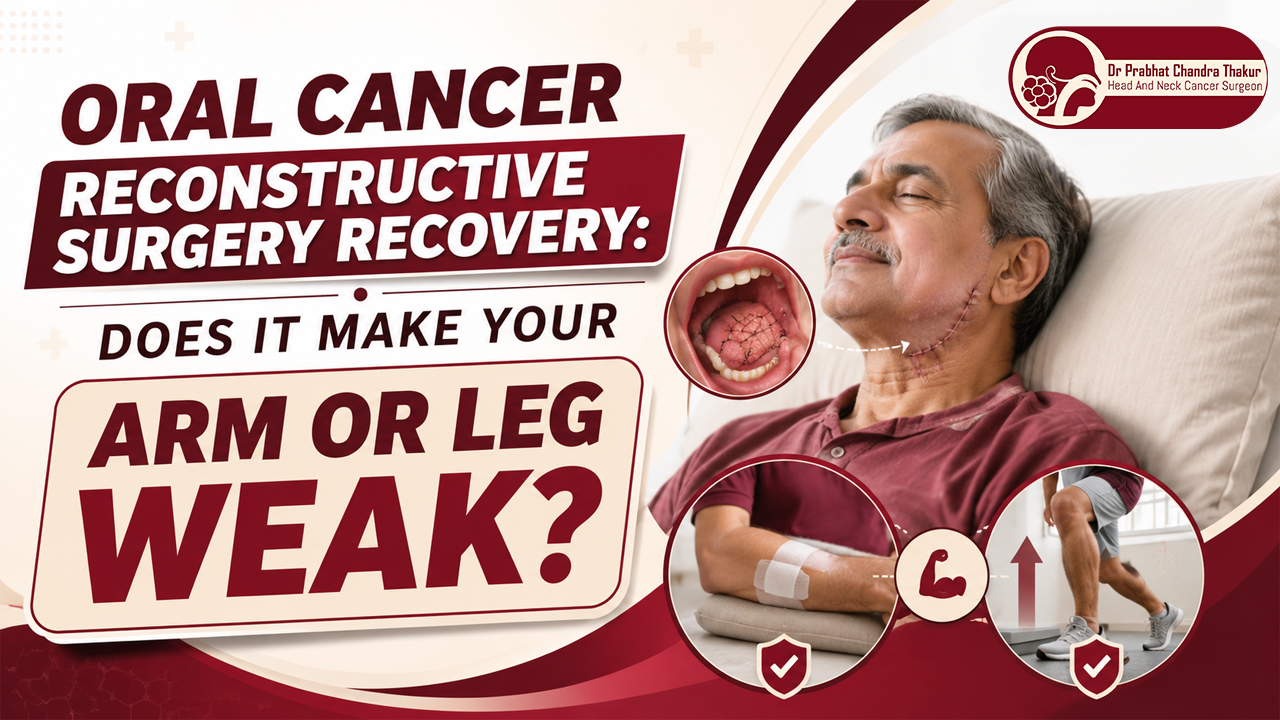
A common concern about oral cancer reconstructive surgery recovery is whether removing tissue from the arm or bone from the leg will leave that body part permanently weak.
In most cases, reconstructive surgeons choose donor tissue or bone carefully so patients can retain useful arm function and gradually return to walking. However, temporary soreness, weakness, stiffness, numbness, and scarring are possible. Some patients experience longer-lasting changes, and serious complications can occur, although they are less common.
The exact outcome depends on the type of reconstruction, the donor site, the patient’s overall health, and postoperative rehabilitation.
Understanding what happens to the arm or leg can help patients and families make informed decisions without relying on unrealistic promises or unnecessary fear.
What is oral cancer reconstructive surgery?
Oral cancer reconstructive surgery repairs parts of the mouth, tongue, cheek, upper jaw, or lower jaw after cancerous tissue has been removed.
Depending on the extent of surgery, reconstruction may involve transferring skin, soft tissue, muscle, bone, and blood vessels from another part of the body. The area where this material is taken is called the donor site.
When surgeons completely transfer tissue along with its blood vessels and reconnect those vessels in the head or neck, the procedure is called a free flap reconstruction.
The purpose is not simply to close a surgical wound. Reconstruction can help restore important functions such as:
- Speaking.
- Swallowing.
- Chewing.
- Maintaining facial structure.
- Supporting future dental rehabilitation.
Memorial Sloan Kettering Cancer Center explains that reconstruction may be performed during the same operation as oral cancer removal, with tissue commonly taken from the forearm, thigh, or lower leg depending on the part of the mouth being repaired. Memorial Sloan Kettering: Mouth cancer surgery and reconstruction
For additional background, read about head and neck cancer surgery and reconstruction.
Why do surgeons use tissue or bone from the arm or leg?
Surgeons use donor tissue because different parts of the mouth require different types of reconstruction.
A tongue or cheek usually needs soft, flexible tissue that can help recreate the lining and shape of the mouth. A jaw, however, may require strong bone capable of restoring facial support and potentially accommodating future dental treatment.
The forearm, thigh, and fibula are considered because they can provide suitable tissue with a dependable blood supply. Nevertheless, selecting a donor site always requires balancing two priorities:
- Reconstructing the mouth effectively.
- Minimizing the impact on the body part providing the tissue or bone.
The best donor site is not automatically the same for every patient. A person’s circulation, occupation, existing mobility, medical history, and reconstructive needs all influence the decision.
What types of donor tissue are used in oral cancer reconstruction?
| Reconstruction option | Common use | Potential donor-site effects | Recovery consideration |
|---|---|---|---|
| Radial forearm free flap | Tongue, cheek, mouth lining, and other soft-tissue defects | Arm scarring, temporary weakness, numbness, or altered sensation | Hand and wrist function should be monitored during healing. |
| Fibula free flap | Lower or upper jaw reconstruction | Leg soreness, temporary walking difficulty, ankle stiffness, or numbness | Walking usually resumes gradually with clinical guidance. |
| Anterolateral thigh flap | Larger soft-tissue defects involving the tongue, cheek, or throat | Thigh soreness, scarring, or temporary weakness | Mobility depends on how much tissue is removed and the individual recovery plan. |
| Other bone-containing flaps | Selected jaw or facial reconstruction cases | Effects depend on whether tissue comes from the shoulder, hip, or another site. | Alternative options should be discussed when a particular donor site is unsuitable. |
The practical difference is that a forearm flap generally addresses soft-tissue reconstruction, while a fibula flap is commonly considered when the jaw requires bone replacement.
The website’s existing discussion of jaw and maxillary reconstruction options provides additional context on when different reconstructive approaches may be appropriate.
Will taking tissue from the arm make the hand weak?
A radial forearm flap does not usually mean the hand will stop functioning. However, the donor arm can feel weaker after surgery, particularly while the wound, skin graft, and surrounding tissues are healing.
The procedure typically involves taking skin, soft tissue, and blood vessels from the inner forearm. The resulting donor-site wound may require a skin graft, and the arm may initially be protected with a dressing, splint, or cast.
Cambridge University Hospitals notes that patients can experience reduced hand strength, altered sensation around the thumb, and increased sensitivity to cold. Numbness may improve over time, but it can occasionally persist. Cambridge University Hospitals: Radial forearm free flap
What symptoms can occur in the arm?
After forearm flap surgery, patients may notice:
- Soreness near the wrist or forearm.
- Temporary difficulty gripping objects firmly.
- Swelling or stiffness around the wrist.
- Numbness or tingling near the thumb.
- A visible scar or skin-graft area.
- Increased sensitivity to cold.
- Reduced endurance during repetitive hand movements.
These effects do not necessarily mean the arm has been permanently damaged. Some limitations reflect normal healing, temporary protection of the wound, or reduced activity after a major operation.
However, recovery may be more important for someone whose work depends on fine hand movements or strong grip, such as a tailor, musician, driver, craftsperson, mechanic, or manual worker.
Patients should tell their surgeon which hand they rely on most and describe any existing hand problems before surgery.
Does arm weakness always disappear completely?
No. Many people regain useful hand function, but complete recovery cannot be guaranteed.
The final outcome depends on the size of the flap, whether nerves are affected, wound healing, rehabilitation, and individual differences. Persistent numbness, reduced grip strength, or discomfort can occur in some patients.
A realistic explanation is that forearm reconstruction is designed to preserve practical arm and hand function, while acknowledging that the donor site may not feel exactly as it did before surgery.
Will removing the fibula bone make the leg permanently weak?
Removing part of the fibula does not automatically prevent a person from walking. The fibula is the smaller bone on the outer side of the lower leg, while the tibia carries much of the body’s weight.
In a fibula free flap, surgeons remove a selected segment of fibula together with its blood vessels and, when necessary, surrounding soft tissue. That bone is then shaped and used to reconstruct the upper or lower jaw.
Cambridge University Hospitals explains that much of the fibula can be removed without preventing walking or weight bearing, and that significant long-term walking problems are often avoided. However, individual recovery varies. Cambridge University Hospitals: Fibula free flap surgery
Can patients walk after fibula flap surgery?
Many patients begin assisted walking within the first several days once their surgical team confirms that weight bearing is appropriate.
Some patients require a walking frame, stick, protective boot, or physiotherapy. Others may need to avoid putting weight on the operated leg for a period because of wound healing, skin grafts, or other individual factors.
The important point is that the timeline should be determined by the treating team. A patient should not attempt to walk independently simply because someone else recovered faster.
Walking may initially feel uncomfortable because of:
- Leg soreness.
- Swelling.
- Ankle stiffness.
- Reduced confidence.
- Temporary muscle weakness.
- Dressings or protective supports.
- Healing of a skin-graft area.
As these problems improve, many patients gradually return to everyday walking. More demanding activities, such as climbing steep stairs, carrying heavy loads, running, or walking long distances, may require additional recovery time.
Are permanent walking problems possible?
Yes, lasting problems are possible, although they are not the expected outcome for every patient.
Potential concerns include persistent numbness, delayed wound healing, reduced ankle mobility, ongoing discomfort, or changes in walking endurance.
A less common complication is foot drop, which makes it difficult to lift the front of the foot while walking. Leeds Teaching Hospitals identifies foot drop as a recognized but uncommon complication after fibula flap surgery. Leeds Teaching Hospitals: Fibula free flap surgery
Any new inability to lift the foot, worsening numbness, or sudden change in walking ability should be reported promptly.
Is temporary weakness the same as permanent disability?
No. Temporary weakness during recovery is different from permanent loss of function.
After major surgery, the arm or leg may feel less strong because of pain, swelling, protective dressings, reduced activity, or muscle deconditioning. These problems often improve as healing progresses.
Permanent disability refers to a lasting functional problem that continues despite appropriate recovery and rehabilitation. Examples may include persistent nerve injury, prolonged mobility limitations, or significant loss of hand function.
The distinction matters because patients are often frightened by the idea that tissue removal means an arm or leg will become unusable. That is not an accurate description of the intended outcome of reconstructive surgery.
At the same time, it would also be misleading to claim there is no possibility of lasting weakness.
A 2025 peer-reviewed study examined long-term patient-reported function after bone-containing reconstructive flaps. It found measurable functional differences in some patients, including those who had fibula or bone-containing forearm flaps, while concluding that overall donor-site morbidity was acceptable. The study had limitations, including a low survey response rate, and its findings should not be interpreted as a guarantee for any individual patient. Chan and colleagues: Long-term donor-site musculoskeletal outcomes after osseous free flap harvest
The appropriate question is therefore not, “Is there absolutely no risk?” It is, “What is my individual risk, and what can be done to protect function?”
How do surgeons decide which donor site is safest?
Surgeons choose a donor site by considering both the reconstruction required and the patient’s existing physical function.
For example, rebuilding a section of jaw may require bone, while reconstructing part of the tongue may be possible with flexible tissue from the forearm or thigh.
Factors that can influence the choice include:
- The size and location of the oral cancer.
- Whether bone, skin, muscle, or soft tissue is required.
- Blood circulation in the proposed donor area.
- Previous injuries or operations involving the arm or leg.
- Existing difficulty walking or poor ankle function.
- Diabetes, vascular disease, or wound-healing concerns.
- Whether the patient depends on a particular hand for work.
- Future dental rehabilitation needs.
- The availability of suitable alternative donor sites.
Memorial Sloan Kettering notes that imaging, including blood-vessel assessment when indicated, may help determine whether a proposed donor site is appropriate. Memorial Sloan Kettering: Mandibulectomy and fibula free flap reconstruction
Proper oral cancer diagnosis and treatment planning is important because the cancer’s location and extent influence both the operation and reconstruction.
If you are comparing treatment options, consider discussing donor-site risks directly with oral cancer surgeon Dr. Prabhat Chandra Thakur.
What does oral cancer reconstructive surgery recovery look like?
Oral cancer reconstructive surgery recovery involves healing in two places: the reconstructed area of the mouth or jaw and the part of the body where tissue or bone was taken.
Recovery does not follow the same schedule for every person, but it can be understood in phases.
During the first few days
The surgical team closely monitors the reconstructed tissue and its blood supply.
The donor arm or leg may be protected with dressings, a splint, a cast, or a boot. Pain, swelling, and restricted movement can be expected, but they should be monitored and managed by the clinical team.
Patients may begin gentle movement or assisted walking when their surgeon and physiotherapist consider it appropriate.
During the following weeks
The focus shifts toward wound healing, gradually increasing activity, and maintaining joint movement.
A patient with a forearm flap may begin using the hand more normally as the wound improves. A patient with a fibula flap may progress from assisted walking to greater independence.
However, healing may take longer if a skin graft is involved or if complications develop.
Over the following months
Strength, endurance, flexibility, and confidence may continue improving.
Some patients notice that numbness or stiffness takes longer to settle than the surgical wound itself. Patients with physically demanding occupations may need more time before returning to their previous level of work.
Radiotherapy, additional cancer treatment, nutritional problems, or other health conditions can also influence the recovery experience.
For broader guidance, see post-surgery care after oral cancer treatment.
How does physiotherapy help protect arm and leg function?
Physiotherapy helps patients regain movement, improve strength, and return to everyday activities safely.
After fibula flap surgery, rehabilitation may focus on:
- Safe walking.
- Gradual weight bearing when approved.
- Ankle movement.
- Balance and stability.
- Stair climbing.
- Building endurance.
- Returning to work or household activities.
After forearm flap surgery, recovery may include:
- Gentle wrist and finger movement.
- Gradual hand use.
- Improving grip.
- Managing swelling.
- Protecting healing skin grafts.
- Returning to activities requiring hand coordination.
Exercises should be individualized. A movement that is appropriate for one patient may be unsuitable for another if the donor site has a skin graft, wound complication, or additional surgical restriction.
The Royal Marsden’s patient guidance emphasizes that donor-flap sites may require individualized physiotherapy exercises to optimize movement. The Royal Marsden: Physiotherapy after head and neck surgery
Importantly, rehabilitation should not focus only on the donor limb. Patients may also need help with speech, swallowing, jaw movement, nutrition, and adjustment to changes in appearance or daily routine.
The broader process of life after head and neck cancer surgery can continue well beyond the initial hospital stay.
What can slow recovery or increase donor-site problems?
Recovery can be affected by medical conditions, treatment factors, and daily habits.
Potential challenges include:
- Poor circulation.
- Diabetes that is not well controlled.
- Smoking or smokeless tobacco use.
- Inadequate nutrition.
- Infection.
- Delayed wound healing.
- Pre-existing nerve or mobility problems.
- Missing follow-up appointments.
- Returning to strenuous activity too early.
- Not following postoperative movement restrictions.
This does not mean every patient with one of these factors will experience complications. It means the surgical team may need to plan more carefully and provide additional monitoring.
Patients should be honest about tobacco use, existing illnesses, medications, and practical limitations at home.
For example, a person who lives several floors above ground level or whose job involves carrying heavy loads should discuss those demands before surgery. That information may influence rehabilitation planning even if it does not change the donor site itself.
Which symptoms require urgent medical attention?
Some discomfort, swelling, and temporary weakness can be part of recovery. However, certain changes require prompt medical assessment.
Contact the surgical team urgently if there is:
- Increasing redness, warmth, swelling, or pus around the wound.
- Fever or chills.
- Rapidly worsening pain.
- A sudden increase in leg swelling or calf pain.
- A hand or foot that becomes unusually pale, blue, or cold.
- New difficulty moving the fingers or lifting the foot.
- Worsening numbness rather than gradual improvement.
- Significant bleeding.
- A wound that opens or develops an unpleasant smell.
- New difficulty breathing.
Memorial Sloan Kettering advises patients to seek medical guidance for fever, worsening redness, swelling, drainage, breathing difficulty, or other concerning postoperative changes. Memorial Sloan Kettering: Postoperative warning signs
Sudden breathing problems, chest pain, severe bleeding, or major circulation changes should be treated as emergencies. Seek immediate emergency medical care rather than waiting for a routine appointment.
Does reconstruction also affect speech, eating, and dental recovery?
Yes. The purpose of reconstruction includes supporting essential mouth and jaw functions, but recovery may still involve changes in speech, swallowing, chewing, and dental health.
A reconstructed tongue may not move exactly like the original tongue. A rebuilt jaw may require a period of healing before additional dental procedures can be considered.
Depending on the operation, patients may need support from:
- A speech and swallowing therapist.
- A dietitian.
- A physiotherapist.
- A dental or maxillofacial specialist.
- The head and neck surgical team.
The National Cancer Institute notes that speech and swallowing professionals can play an important role in helping patients return to oral intake after cancer treatment. National Cancer Institute: Oral complications of cancer therapies
Patients considering jaw reconstruction should also understand the importance of dental care after head and neck cancer treatment, especially when radiotherapy or future dental rehabilitation may be involved.
What should patients in Nepal consider before reconstructive surgery?
Patients in Kathmandu Valley and other parts of Nepal should consider more than the operation itself.
Practical questions may include:
- How far will the patient need to travel for follow-up?
- Are there stairs, uneven paths, or steep roads near the home?
- Does the patient’s work involve prolonged standing, driving, farming, or carrying heavy loads?
- Will physiotherapy be available locally or through referral?
- Can family members help with dressings, transport, and daily activities?
- Is speech or swallowing support available when needed?
- What should the family do if a complication develops after returning home?
A patient who travels from outside Kathmandu Valley may need clearer arrangements for wound checks, physiotherapy, and urgent contact than someone living near the treatment center.
The goal is not to discourage surgery. It is to make recovery planning realistic and suitable for the patient’s actual daily life.
What questions should you ask your reconstructive surgeon?
Before surgery, consider asking:
- Why is reconstruction necessary in my case?
- Which donor site are you recommending, and why?
- Will the operation involve soft tissue, bone, or both?
- How might the procedure affect my hand strength or walking?
- What donor-site complications are possible?
- Will I need a skin graft?
- When can I start moving my arm or putting weight on my leg?
- Will physiotherapy or hand rehabilitation be necessary?
- How could my job or existing health conditions affect recovery?
- What warning signs should my family watch for?
- What alternative donor sites are available if my arm or leg is unsuitable?
- When can I expect to return to my usual daily activities?
The answers should be specific to your diagnosis, proposed reconstruction, and overall health.
Key takeaways
Oral cancer reconstruction using tissue from the arm or bone from the leg does not automatically cause permanent disability.
Many patients retain useful hand function after forearm reconstruction and gradually return to walking after fibula flap surgery. Nevertheless, temporary weakness, numbness, stiffness, scarring, and longer-lasting complications are possible.
The safest approach is individualized donor-site selection, honest discussion of risks, appropriate rehabilitation, and careful follow-up.
If you or a family member is considering oral cancer reconstruction in Nepal, arrange an oral cancer surgery consultation to discuss treatment options, donor-site concerns, and realistic recovery expectations.
This article is for educational purposes and does not replace personalized advice from a qualified head and neck cancer surgeon. Research and editorial fact-checking date: August 25, 2026. Clinical review by Dr. Prabhat Chandra Thakur is required before publication under his name.
FAQs
Does oral cancer reconstructive surgery always make the arm weak?
No. A forearm flap can cause temporary soreness, reduced grip strength, stiffness, or numbness, but the procedure does not automatically make the arm unusable. Many patients retain practical hand function. Recovery depends on the amount of tissue removed, wound healing, nerve involvement, and rehabilitation.
Can you walk normally after fibula flap surgery?
Many patients gradually return to everyday walking after fibula flap surgery. Early walking may require assistance, a protective boot, or physiotherapy. Some patients experience persistent stiffness, numbness, or reduced endurance, so the expected outcome should be discussed individually with the surgical team.
Why is the fibula used for jaw reconstruction?
The fibula can provide a section of bone suitable for rebuilding parts of the upper or lower jaw. Surgeons may also transfer associated blood vessels and soft tissue. Because the larger tibia carries much of the body’s weight, selected fibula segments can often be used while preserving the ability to walk.
Can removing the fibula cause permanent leg weakness?
Permanent weakness or walking problems are possible, but they are not inevitable. Some people experience ongoing numbness, ankle stiffness, reduced endurance, or uncommon nerve-related problems. The individual risk depends on circulation, existing mobility, surgical technique, wound healing, and rehabilitation.
How long does it take to walk after fibula free flap surgery?
Some patients begin assisted walking within the first few days when approved by their surgical team. Others need a longer period because of skin grafts, wound concerns, or restrictions on weight bearing. Patients should follow their surgeon’s instructions rather than relying on a fixed recovery timeline.
Will a forearm flap affect grip strength?
Grip strength can be temporarily reduced after a radial forearm flap. Some patients also notice wrist stiffness, altered sensation, or increased sensitivity to cold. Improvement may occur as the wound heals and hand use increases, but complete return to preoperative strength cannot be guaranteed.
Is numbness normal after reconstructive flap surgery?
Numbness or tingling can occur around the forearm, thumb, lower leg, or foot after donor-site surgery. These symptoms may improve gradually, but they can sometimes persist. New, rapidly worsening, or severe numbness should be assessed promptly.
Can the thigh be used instead of the arm or lower leg?
Yes. In selected cases, tissue from the thigh can be used to reconstruct parts of the tongue, cheek, or other soft-tissue areas. Whether it is appropriate depends on the size of the defect, the amount of tissue needed, the patient’s anatomy, and the surgeon’s assessment.
Is physiotherapy necessary after oral cancer reconstruction?
Physiotherapy may be helpful, particularly after fibula flap surgery or when the arm becomes stiff or weak after a forearm flap. The type and timing of exercises should be individualized. Some patients may also require speech therapy, swallowing support, nutritional guidance, or dental rehabilitation.
Who should patients consult for oral cancer reconstruction in Nepal?
Patients should consult a qualified oral cancer or head and neck cancer surgeon with relevant reconstructive experience. The consultation should cover cancer treatment, donor-site options, potential complications, rehabilitation, and follow-up arrangements. Patients in Kathmandu Valley may discuss these issues with Dr. Prabhat Chandra Thakur following an individualized clinical assessment.