
Finding a lump in your neck or receiving a thyroid ultrasound report showing a nodule can be worrying. Your doctor may recommend a thyroid FNAC test to understand whether the lump is benign (non-cancerous), suspicious, or malignant (cancerous).
But what exactly is thyroid FNAC? Is the procedure painful? How much does a thyroid FNAC test cost in Nepal? And what do terms such as Bethesda category 2, Bethesda category 3, or Bethesda category 4 mean on your pathology report?
These are important questions for patients undergoing thyroid evaluation in Kathmandu and throughout Nepal.
A thyroid FNAC test is a commonly used, minimally invasive diagnostic procedure that collects cells from a thyroid nodule using a thin needle. The sample is examined under a microscope to help doctors decide whether ultrasound monitoring, repeat testing, further evaluation, or surgery may be appropriate.
This guide explains the thyroid FNAC procedure, preparation, approximate cost in Nepal, interpretation of thyroid FNAC results, the six Bethesda categories, possible side effects, and what patients should do after receiving their reports.
What Is a Thyroid FNAC Test?
FNAC stands for Fine Needle Aspiration Cytology. It is a diagnostic procedure in which a thin needle is inserted into a thyroid lump to collect a small sample of cells for microscopic examination.
The thyroid is a butterfly-shaped gland situated at the front of your neck. It produces hormones that help regulate metabolism, energy use, heart function, and body temperature.
Sometimes, small growths called thyroid nodules develop inside this gland. Most thyroid nodules are benign, but a small proportion may contain cancerous cells.
A thyroid FNAC test helps distinguish nodules that are likely benign from those requiring further investigation.
The test is also known by several names:
-
Thyroid fine needle aspiration (FNA)
-
Thyroid needle biopsy
-
Thyroid nodule biopsy
-
Fine needle aspiration biopsy (FNAB)
-
Thyroid lump FNAC
-
Ultrasound-guided thyroid FNAC
In clinical practice, thyroid FNA and thyroid FNAC are commonly used interchangeably. Unlike a surgical biopsy, the procedure does not usually require an incision, stitches, or general anesthesia.
However, FNAC evaluates cells rather than the complete structure of a tissue specimen. This is why certain thyroid tumors cannot be definitively classified through FNAC alone.
For more background, read our guide on thyroid nodules versus thyroid cancer.
When Is FNAC Recommended for Thyroid Nodules?
Not every thyroid lump requires a biopsy.
Doctors generally recommend thyroid nodule FNAC after reviewing the patient's symptoms, physical examination, ultrasound findings, thyroid function tests, and relevant risk factors.
A thyroid FNAC may be recommended in the following situations.
1. A suspicious thyroid nodule on ultrasound
A thyroid ultrasound can identify features such as an irregular shape, suspicious margins, very low echogenicity, or tiny echogenic foci suggestive of microcalcifications.
These findings may increase concern for thyroid cancer, depending on the nodule's overall appearance.
2. A thyroid lump that is growing or changing
A thyroid swelling that increases in size or develops new suspicious features should be reassessed.
Growth alone does not confirm cancer, but it may influence the decision to repeat imaging or perform a thyroid nodule biopsy.
3. Enlarged or suspicious neck lymph nodes
Some thyroid cancers can spread to nearby lymph nodes. When an ultrasound identifies suspicious lymph nodes, a doctor may recommend needle sampling of the affected node as part of the evaluation.
4. Important clinical risk factors
A personal history of radiation exposure to the head or neck, particularly during childhood, or a strong family history of certain thyroid cancers may influence the diagnostic plan.
5. Persistent symptoms requiring further assessment
A thyroid lump associated with persistent hoarseness, difficulty swallowing, pressure in the neck, or breathing problems needs clinical evaluation.
These symptoms are not necessarily caused by cancer, but they should not be ignored.
Important: FNAC decisions depend on ultrasound risk patterns and nodule size, not simply whether a lump is visible or palpable. Small, low-risk nodules often need monitoring rather than immediate biopsy.
Learn more about silent symptoms and early diagnosis of thyroid cancer.
How Is a Thyroid FNAC Test Performed?
The thyroid FNAC procedure is usually completed as an outpatient investigation. Most patients can return home shortly afterward.
Here is what generally happens during an ultrasound-guided FNAC thyroid test.
Step 1: Clinical evaluation
The clinician reviews your symptoms, thyroid ultrasound report, medical history, and medications. The location and size of the nodule are confirmed.
Step 2: Positioning
You lie on an examination bed, usually on your back with your neck gently extended. A small pillow may be placed beneath your shoulders.
Step 3: Ultrasound guidance
An ultrasound probe is placed over the neck to locate the thyroid nodule accurately.
During a USG-guided FNAC thyroid procedure, real-time ultrasound helps the clinician direct the needle into the intended part of the nodule while avoiding nearby structures.
Step 4: Needle aspiration
After cleaning the skin, the clinician inserts a fine needle into the nodule to collect cells.
A local anesthetic may be used, although it is not always necessary.
Sometimes several passes are required to obtain enough material for examination. Patients are usually asked to remain still and avoid swallowing or talking while the needle is being used.
Step 5: Cytology examination
The collected cells are prepared on slides or in a liquid-based medium and sent to a pathology laboratory.
A cytopathologist examines them and prepares a thyroid FNAC report, often using the Bethesda classification system.
How long does a thyroid FNAC take?
The needle sampling itself usually takes only a few minutes. The entire appointment may take approximately 10–30 minutes or longer depending on preparation, ultrasound evaluation, and the number of samples needed.
You can learn about the technique from the American Thyroid Association's patient guide to thyroid fine needle aspiration.
Is Thyroid FNAC Painful? Preparation Before the Test
One of the most frequent patient concerns is whether a thyroid FNAC test is painful.
Most people experience a brief needle prick, pressure, or mild discomfort. The experience is often comparable to a blood test, although some patients may feel more discomfort because the needle is placed in the neck.
How should you prepare?
In most cases, little special preparation is needed.
You should:
-
Bring your previous thyroid ultrasound reports and relevant blood test results.
-
Tell your doctor if you take aspirin, warfarin, clopidogrel, apixaban, or other medicines that affect bleeding.
-
Inform the clinical team about any bleeding disorder or relevant medical condition.
-
Wear comfortable clothing that allows easy access to your neck.
-
Ask whether the hospital has specific instructions for your procedure.
Do not stop prescribed blood-thinning medicines without instructions from the clinician managing them.
Is fasting required before FNAC?
Fasting before FNAC is generally unnecessary when thyroid FNAC is performed using local anesthesia or without anesthesia.
If sedation or another procedure is planned, the hospital may provide different instructions.
Can you eat after the test?
Most patients can eat and drink normally afterward, unless their treating clinician provides specific instructions.
Thyroid FNAC Test Cost in Nepal
The thyroid FNAC test cost in Nepal varies depending on the hospital, diagnostic center, procedure technique, and services included.
Patients looking for FNAC test prices in Kathmandu should understand that the charge for collecting a specimen and the charge for examining it under a microscope may be listed separately.
How much does a thyroid FNAC test cost in Kathmandu?
As examples of publicly listed prices checked in November 2026:
| Provider | Published pricing example |
|---|---|
| Kathmandu PathLab | FNAC cytology: NPR 2,100; a separate FNAC procedure charge of NPR 1,575 is also listed |
| KCC | Approximately NPR 2,000–4,000 for an ultrasound-guided thyroid FNAC biopsy |
These figures are examples from individual providers, not a standard Nepal-wide tariff or the fee charged by Dr. Prabhat or Nepal Cancer Hospital.
Pricing references: Kathmandu PathLab test listing and KCC thyroid treatment information.
What affects the total FNAC cost?
The final thyroid biopsy cost in Nepal may vary depending on:
-
Whether ultrasound guidance is included
-
The FNAC procedure or needle-sampling charge
-
Cytology laboratory and pathology reporting fees
-
Additional slides, repeat sampling, or special testing
-
Hospital registration and consultation charges
-
Facility location and available diagnostic services
A USG-guided FNAC may have a different price from a procedure without ultrasound guidance.
If you are comparing an FNAC test hospital in Kathmandu or searching for an FNAC test near you, ask whether the quoted amount includes both the procedure and the final cytopathology report.
Patients should confirm the latest charges with the chosen provider before booking.
Understanding Thyroid FNAC Results and the Bethesda Classification
Receiving a thyroid FNAC report can be confusing, especially when it contains medical terms such as atypia, follicular neoplasm, or suspicious for malignancy.
To make reports more consistent, pathologists use the Bethesda System for Reporting Thyroid Cytopathology.
The system classifies thyroid FNAC findings into six diagnostic categories, commonly called Bethesda categories 1 to 6.
The updated 2023 Bethesda System assigns each category a specific name and an estimated risk of malignancy based on published evidence.
Bethesda Categories 1–6 Explained
| Bethesda category | Report meaning | Estimated average malignancy risk in adults |
|---|---|---|
| I | Nondiagnostic | 13% |
| II | Benign | 4% |
| III | Atypia of Undetermined Significance (AUS) | 22% |
| IV | Follicular Neoplasm | 30% |
| V | Suspicious for Malignancy | 74% |
| VI | Malignant | 97% |
Source: The 2023 Bethesda System for Reporting Thyroid Cytopathology, third edition. Percentages are population-level estimates, substantially influenced by which nodules proceed to surgery. They are not a personalized prediction and may differ between hospitals, age groups, and patient populations.
For the original medical classification, see the 2023 Bethesda System publication indexed in PubMed.
Bethesda Category I: Nondiagnostic
A Bethesda 1 thyroid report means the collected sample did not contain enough suitable material for a reliable diagnosis.
This may happen when the sample contains too few thyroid cells, mostly cyst fluid, or material obscured by blood.
A nondiagnostic thyroid FNAC does not automatically mean cancer or a benign condition.
What happens next? A doctor may recommend repeating the FNAC under ultrasound guidance or considering other steps based on the ultrasound appearance and clinical findings.
Bethesda Category II: Benign
A Bethesda 2 thyroid report indicates that the cells appear benign.
The findings may be consistent with a colloid nodule, benign follicular nodular disease, or certain inflammatory thyroid conditions.
The estimated average malignancy risk for Bethesda II in the 2023 system is approximately 4%, although the risk depends on the population studied.
What happens next? Most patients are monitored through clinical follow-up and thyroid ultrasound rather than immediate surgery.
Surgery may still be considered for a benign nodule if it causes significant pressure symptoms, swallowing difficulties, or other problems.
Bethesda Category III: Atypia of Undetermined Significance (AUS)
A Bethesda 3 thyroid nodule has some unusual cellular features, but the findings are insufficient to classify it confidently as benign or malignant.
Older reports may use the expression FLUS (follicular lesion of undetermined significance). The 2023 system uses AUS as the standardized category name.
Bethesda category 3 has an estimated average malignancy risk of approximately 22%.
Importantly, Bethesda 3 does not mean that the patient has thyroid cancer.
Depending on the ultrasound findings, nodule size, patient preferences, and available testing, doctors may recommend repeat FNAC, molecular testing, continued observation, or diagnostic surgery.
Bethesda Category IV: Follicular Neoplasm
A Bethesda 4 thyroid result suggests a follicular-patterned neoplasm.
It may represent a benign follicular adenoma or a malignant follicular thyroid carcinoma.
The distinction is sometimes impossible through FNAC because follicular carcinoma is diagnosed by examining features such as capsular or vascular invasion in a tissue specimen.
The estimated average malignancy risk for Bethesda IV is approximately 30%.
What happens next? Diagnostic thyroid lobectomy may be recommended in selected patients. Molecular testing may also be considered where available and clinically appropriate.
Not every Bethesda 4 thyroid report requires immediate removal of the entire thyroid gland.
Bethesda Category V: Suspicious for Malignancy
A Bethesda 5 thyroid report means the sampled cells have features strongly suggestive of cancer, although the findings are not fully diagnostic.
The estimated average malignancy risk is approximately 74%.
The next step usually involves specialist assessment and discussion of treatment options, which may include surgery.
The appropriate operation depends on the suspected cancer type, tumor characteristics, lymph node findings, and other clinical factors.
Bethesda Category VI: Malignant
A Bethesda 6 thyroid report indicates cytological findings diagnostic of malignancy.
The estimated average malignancy risk in this category is approximately 97%.
Papillary thyroid carcinoma is one of the common diagnoses in this category.
Patients generally need specialist assessment and a treatment plan. Surgery is a common treatment for many thyroid cancers, but the choice of surgery and any additional treatment must be individualized.
Read more about when thyroid surgery is recommended.
How Accurate Is a Thyroid FNAC Test?
Thyroid FNAC is widely accepted as a useful diagnostic method for evaluating thyroid nodules, particularly when combined with ultrasound.
However, no diagnostic test is perfect.
The accuracy of thyroid FNAC depends on the quality of sampling, the characteristics of the nodule, the clinician performing the procedure, and the interpretation by the cytopathologist.
Can thyroid FNAC give a false-negative result?
Yes. A false-negative thyroid FNAC result occurs when a sample is reported as benign even though a malignant area is present.
This is uncommon but possible, particularly when a nodule contains different types of tissue or the suspicious area was not sampled.
For this reason, a benign report must still be interpreted alongside the ultrasound findings and medical history.
Can a thyroid FNAC report be inconclusive?
Yes. Bethesda I indicates insufficient diagnostic material, while Bethesda III and IV represent different forms of indeterminate cytology.
An inconclusive FNAC result does not automatically justify surgery. The appropriate next step depends on the individual patient's risk assessment.
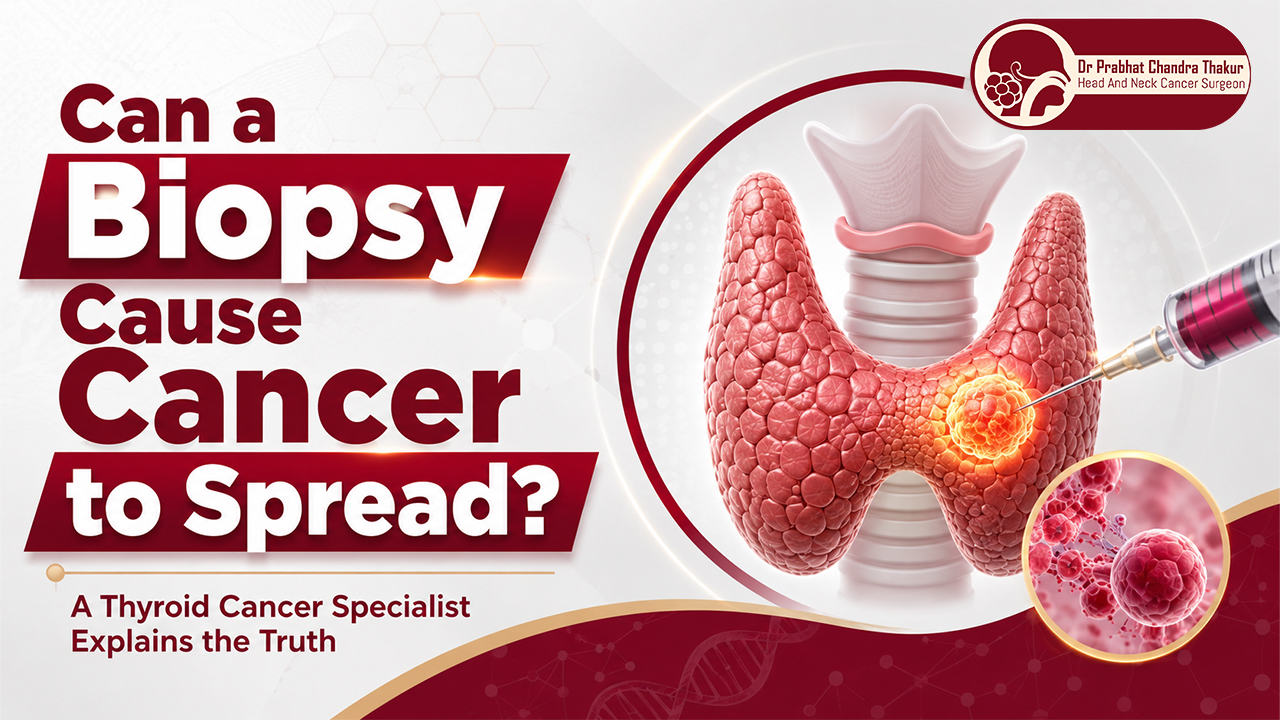
Can a biopsy cause thyroid cancer to spread?
Needle-track implantation of cancer cells after thyroid FNAC has been reported but is exceptionally rare.
For most patients, the diagnostic benefit outweighs this small risk when FNAC is appropriately recommended.
For a more detailed explanation, read Can a Biopsy Cause Cancer to Spread?.
Side Effects and Recovery After Thyroid FNAC
Thyroid FNAC is generally a safe procedure.
Most patients experience either no symptoms or temporary mild discomfort.
Possible side effects include:
-
Mild pain or tenderness at the needle site
-
Minor bruising
-
A small amount of local swelling
-
Temporary discomfort while swallowing
-
Minor bleeding under the skin
Serious bleeding, infection, or injury to surrounding structures is rare.
How long is thyroid FNAC recovery?
Most patients can resume ordinary activities on the same day, depending on their clinician's instructions.
Mild soreness generally improves over the following day or two.
The healthcare team may advise avoiding strenuous physical activity for a short period, especially when there has been bruising or bleeding.
When should you seek medical attention?
Contact the treating team if you experience increasing pain, persistent bleeding, expanding neck swelling, fever, or unusual symptoms after the procedure.
Rapidly enlarging neck swelling, breathing difficulty, or significant new swallowing difficulty requires emergency medical evaluation.
Thyroid FNAC vs Thyroid Ultrasound: What Is the Difference?
Thyroid ultrasound, thyroid FNAC, and blood tests provide different types of information.
| Test | What it evaluates |
|---|---|
| Thyroid ultrasound | Nodule size, shape, location, composition, and suspicious imaging features |
| Thyroid FNAC | Microscopic appearance of cells collected from a thyroid nodule |
| TSH and thyroid function tests | How the thyroid gland is functioning |
| Core needle biopsy | A larger tissue sample in selected cases where additional tissue information is needed |
TI-RADS vs Bethesda Classification
A frequent source of confusion is the difference between a TI-RADS score on an ultrasound report and a Bethesda category on a thyroid FNAC report.
TI-RADS is a system used to assess thyroid nodules based on ultrasound characteristics.
For example, an ACR TI-RADS report may describe a nodule as TR3, TR4, or TR5, with increasing levels of suspicion.
Bethesda, on the other hand, classifies the cellular findings of the FNAC sample.
In simple terms:
-
TI-RADS: How suspicious does the nodule look on ultrasound?
-
Bethesda: What do the sampled cells look like under a microscope?
These systems complement rather than replace each other.
For example, a thyroid nodule may appear suspicious on ultrasound but produce a benign cytology report. Such discordance may justify additional assessment rather than automatically concluding that the nodule is harmless.
Similarly, a normal TSH blood test cannot rule out thyroid cancer.
You can also read the American Thyroid Association's guide to thyroid nodules for further patient information.
What Happens After Receiving Your Thyroid FNAC Report?
The next step after thyroid FNAC depends on the Bethesda category and the overall clinical findings.
If the report is benign: Your doctor may recommend periodic ultrasound monitoring.
If the sample is nondiagnostic: A repeat ultrasound-guided FNAC may be considered.
If the report is indeterminate: Repeat sampling, additional testing, specialist discussion, or diagnostic lobectomy may be appropriate.
If the report is suspicious or malignant: A thyroid specialist or experienced thyroid surgeon should review the results and discuss the treatment plan.
Is thyroid surgery always necessary after FNAC?
No.
Many thyroid nodules can be safely monitored, and even some higher-risk findings require an individualized decision about the extent and timing of treatment.
When surgery is indicated, options may include thyroid lobectomy, total thyroidectomy, or selected minimally invasive approaches.
Dr. Prabhat Chandra Thakur provides specialist evaluation and surgical management of thyroid disorders and thyroid cancer at Nepal Cancer Hospital & Research Center, Harisiddhi, Lalitpur.
For patients who may require an operation, learn about remote-access endoscopic thyroid surgery and its suitability.
Not every patient is suitable for an endoscopic or scar-concealing procedure. The best approach depends on medical safety, tumor characteristics, and surgical assessment.
Thyroid FNAC Test and Bethesda Report: A Quick Explanation in Nepali
नेपालमा थाइराइडको गाँठो (Thyroid Nodule) देखिएपछि चिकित्सकले थाइराइड FNAC टेस्ट गर्न सल्लाह दिन सक्नुहुन्छ।
यस परीक्षणमा सानो सुई प्रयोग गरेर थाइराइडको गाँठोबाट केही कोषहरू निकालिन्छ र प्रयोगशालामा जाँच गरिन्छ।
थाइराइड FNAC रिपोर्ट मा Bethesda 1 देखि Bethesda 6 सम्मको वर्गीकरण देखिन सक्छ।
-
Bethesda 1: परीक्षणका लागि पर्याप्त कोष प्राप्त नभएको अवस्था।
-
Bethesda 2: सामान्यतया क्यान्सर नभएको अर्थात् Benign नतिजा।
-
Bethesda 3 र 4: थप मूल्याङ्कन आवश्यक हुन सक्ने अनिश्चित नतिजा।
-
Bethesda 5: क्यान्सरको उच्च शङ्का भएको अवस्था।
-
Bethesda 6: क्यान्सरसँग मेल खाने कोषहरू देखिएको अवस्था।
Bethesda 3 वा Bethesda 4 आउँदैमा क्यान्सर भएको निश्चित हुँदैन।
थाइराइड FNAC रिपोर्टको अर्थ बुझ्न, शल्यक्रिया आवश्यक छ कि छैन भनेर निर्णय गर्न, र उचित उपचार योजना बनाउन विशेषज्ञ चिकित्सकसँग परामर्श गर्नु महत्त्वपूर्ण हुन्छ।
थाइराइड बायोप्सी खर्च नेपालमा अस्पताल, प्रयोगशाला र अल्ट्रासाउन्डको आवश्यकता अनुसार फरक हुन सक्छ।
Frequently Asked Questions About Thyroid FNAC in Nepal
1. What is the main purpose of a thyroid FNAC test?
Thyroid FNAC collects cells from a thyroid nodule to help determine whether the nodule appears benign, indeterminate, suspicious, or malignant. It is an important investigation for selecting further treatment or monitoring.
2. How much does a thyroid FNAC test cost in Nepal?
The thyroid FNAC cost depends on the hospital and whether ultrasound guidance, sampling, and cytology reporting are included. Published provider examples range from individual cytology charges of around NPR 2,100 to approximate ultrasound-guided FNAC packages of NPR 2,000–4,000. Confirm the complete current price directly with your hospital.
3. Is a thyroid FNAC test painful?
Most patients feel brief discomfort or pressure during the needle procedure. Significant pain is not typical, although individual experiences vary.
4. How many days does it take to get a thyroid FNAC report?
A thyroid FNAC report may be ready within a few days, but some reports can take up to approximately two weeks depending on laboratory processing and whether additional examination is required. Ask the laboratory for its current turnaround time.
5. Does a thyroid FNAC test confirm cancer?
A malignant Bethesda VI result can establish a cytological diagnosis of cancer, but other categories may be benign, suspicious, or indeterminate. FNAC cannot definitively distinguish every thyroid tumor type, and some diagnoses require surgical histopathology.
6. What does Bethesda category 2 mean?
Bethesda category 2 indicates benign cytology. Most patients can be monitored, although ultrasound findings and symptoms still determine follow-up.
7. What does Bethesda category 3 mean in a thyroid FNAC report?
Bethesda III means atypia of undetermined significance. It does not confirm thyroid cancer. Your doctor may discuss repeat FNAC, molecular testing, observation, or diagnostic surgery depending on the overall assessment.
8. Does Bethesda category 4 always require thyroid surgery?
Not always. Bethesda IV indicates a follicular neoplasm, and diagnostic lobectomy is a common option. The decision depends on ultrasound findings, clinical risk, additional testing, and patient preferences.
9. What is the difference between Bethesda 5 and Bethesda 6?
Bethesda V is suspicious for malignancy, whereas Bethesda VI is diagnostic of malignancy on cytology. Both require specialist evaluation, but the certainty of the cytological diagnosis differs.
10. Can thyroid FNAC results be wrong?
Yes. False-negative, indeterminate, and nondiagnostic results are possible. A reliable thyroid evaluation combines the FNAC result with ultrasound findings, symptoms, and clinical risk factors.
11. Is ultrasound-guided FNAC better than FNAC without ultrasound?
Ultrasound guidance helps locate and sample the intended nodule, particularly when it is small, difficult to feel, or contains different components. It is widely used to improve sampling accuracy.
12. Can I go home immediately after thyroid FNAC?
Usually, yes. Thyroid FNAC is generally an outpatient procedure, and most patients return to routine activities shortly afterward.
13. What should I do if my thyroid FNAC is benign but the lump is growing?
Arrange reassessment with your doctor. Significant growth or new suspicious ultrasound findings may warrant repeat imaging, further sampling, or another treatment decision.
14. Who should I consult for an abnormal thyroid FNAC report in Nepal?
An endocrinologist, ENT head and neck specialist, or experienced thyroid surgeon can assess your thyroid FNAC report together with ultrasound findings and discuss suitable next steps.
Consult Dr. Prabhat Chandra Thakur for Thyroid FNAC Report Evaluation
If you have a thyroid lump, an abnormal ultrasound finding, or a Bethesda category that you do not understand, specialist evaluation can help clarify the diagnosis and available treatment options.
Dr. Prabhat Chandra Thakur is a consultant ENT, head and neck surgeon and Thyroid oncosurgeon with specialized training in thyroid and head and neck surgery.
He practices at Nepal Cancer Hospital & Research Center, Harisiddhi, Lalitpur, Nepal, where patients can seek evaluation of thyroid nodules, suspicious FNAC findings, and conditions that may require surgery.
For a specialist assessment, bring:
-
Your thyroid ultrasound report
-
Original thyroid FNAC or biopsy report
-
Previous thyroid blood test results
-
Earlier imaging, if available
-
A list of current medications
A consultation can help you understand whether monitoring, repeat testing, or surgical assessment is appropriate.
Book a thyroid consultation: Schedule an appointment with Dr. Prabhat Chandra Thakur
Consultation location: Nepal Cancer Hospital & Research Center, Harisiddhi, Lalitpur, Nepal
OPD hours: Sunday–Friday, 10:00 AM–4:00 PM
Contact: 9841216728
For information about his professional training and clinical services, visit the profile of Dr. Prabhat Chandra Thakur.
Follow Dr. Prabhat for Thyroid and Head & Neck Health Awareness
Stay connected for educational content about thyroid disorders, early cancer detection, surgical treatment, and head and neck health.
You can also explore more thyroid cancer and surgery articles on our website.
Medical References
The medical explanations in this article are based on established thyroid diagnostic guidance and standardized cytopathology terminology.
-
American Thyroid Association. Fine Needle Aspiration Biopsy of Thyroid Nodules: Procedure and Interpretation.
-
American Thyroid Association. Thyroid Nodules: Diagnosis, Ultrasound and Biopsy.
-
Ali SZ et al. (2023). The 2023 Bethesda System for Reporting Thyroid Cytopathology. Thyroid. DOI: 10.1089/thy.2023.0141.
-
Bethesda clinical guidance. Adult Bethesda Cytology Categories, Risk of Malignancy and Clinical Management.
Medical disclaimer: This article is intended for general patient education. It does not replace an individual medical consultation, diagnosis, or treatment recommendation. The need for biopsy, monitoring, further testing, or thyroid surgery must be determined by a qualified clinician based on the patient's complete evaluation.
Clinical Disclaimer: This educational guide is authored by Dr. Prabhat Chandra Thakur for patient awareness and early cancer detection. It does not replace an in-person physical examination, endoscopic evaluation, or tissue biopsy.